Introduction
Every clinic in India, whether it is a busy multispecialty hospital in Mumbai or a general practice in a Tier 2 city like Indore or Coimbatore, faces one common operational challenge every day: managing patient appointments efficiently.
Long queues at the reception counter, patients waiting without a clear understanding of their turn, missed appointments with no prior notice, and front-desk staff overwhelmed with phone calls during consultation hours can directly affect patient satisfaction and clinic revenue.
Appointment scheduling software for clinics offers a practical solution to these challenges. It brings the process of booking, managing, and following up on patient appointments into a single digital system. Patients can book appointments conveniently, while clinic administrators gain better visibility into the day's patient flow.
As patient expectations continue to evolve, particularly among urban and digitally connected populations, clinics that depend entirely on phone-based or walk-in appointment systems may struggle to provide the convenience patients increasingly expect.
Appointment scheduling software can help clinics create a more streamlined experience while improving operational efficiency, reducing missed appointments, supporting better patient communication, and creating opportunities for sustainable growth.
This guide explores the benefits of appointment scheduling software for clinics, explains how it works, and examines why it is becoming increasingly relevant for Indian healthcare providers.
What Is Appointment Scheduling Software for Clinics?
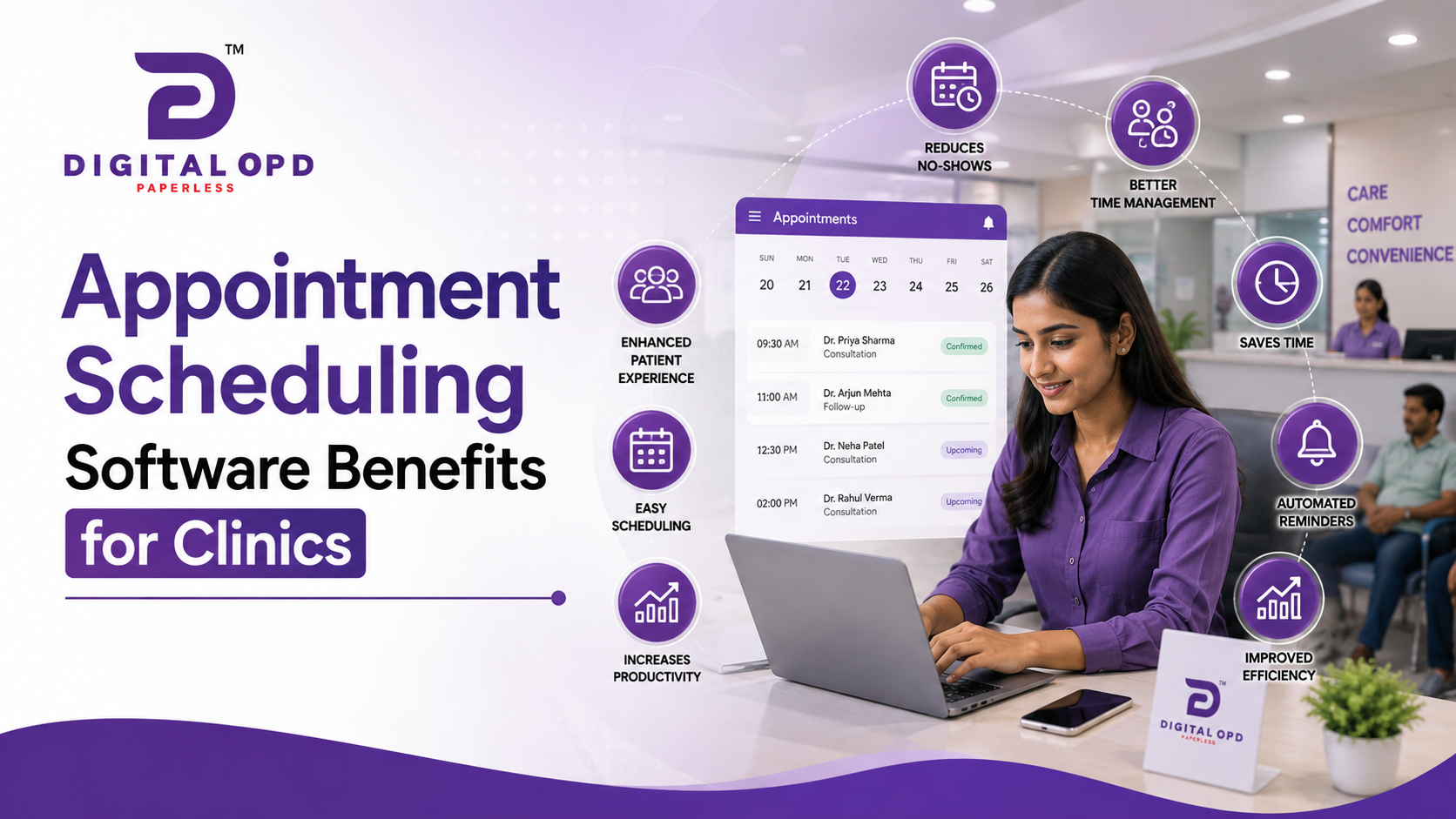
Appointment scheduling software is a digital platform that allows patients to view available doctor time slots and book confirmed appointments online without having to call the clinic or visit in person.
Once an appointment is booked, the system can update the clinic's appointment calendar, send confirmation messages, and provide automated reminders as the appointment date approaches.
From the clinic's perspective, the software provides the reception team with an organized view of appointments based on doctor, time slot, and appointment type.
This can reduce the confusion associated with handwritten registers, overlapping bookings, and repeated phone-based communication.
Common Features of Appointment Scheduling Software
Modern appointment scheduling platforms designed for clinics may include several features that help streamline the outpatient workflow.
Doctor-wise slot configuration allows clinics to create different appointment schedules for different doctors and specialties.
Token number generation and digital queue displays can help patients understand their position while waiting at the clinic.
Automated SMS and WhatsApp reminders can notify patients before their appointments.
Online pre-registration forms can reduce paperwork and repetitive data entry at the reception desk.
Integration with billing and electronic prescription modules can help connect appointment management with the broader OPD workflow.
The result is a more organized digital environment where the patient journey can be managed from the initial booking through consultation and follow-up.
Key Benefits of Appointment Scheduling Software for Clinics
1. Significant Reduction in Patient No-Shows
One of the most important benefits of appointment scheduling software is its potential to reduce patient no-shows.
A no-show occurs when a patient books an appointment but does not attend and does not notify the clinic in advance. For clinics, this creates an unused appointment slot, potential revenue loss, and missed opportunities to accommodate another patient.
Online scheduling combined with automated reminders can help address this challenge. Patients receive notifications before their appointments and may have the option to confirm, cancel, or reschedule their visit.
For Indian clinics, this can be particularly valuable when patients travel significant distances for specialist consultations. An automated reminder can encourage patients to make changes in advance, giving the clinic an opportunity to offer the vacant slot to another patient.
2. Reduced Front-Desk Workload
In clinics without appointment scheduling software, front-desk teams often spend a considerable amount of time answering calls related to appointment availability, bookings, cancellations, and rescheduling.
This phone-heavy workflow can create bottlenecks during busy periods and take staff attention away from patients who are physically present at the clinic.
Online self-booking can reduce the volume of routine appointment-related calls. Front-desk employees can then focus more on patient check-in, billing support, documentation, and direct patient assistance.
This can improve staff productivity while creating a more responsive experience at the reception desk.
3. Better Queue Management and Reduced Waiting Time
Unstructured queues are a common source of frustration for patients.
When patients arrive without defined appointment times and have little visibility into how many people are ahead of them, waiting can become stressful and unpredictable.
Appointment scheduling software can address this by assigning confirmed time slots based on doctor availability.
Patients who know their appointment time may not need to arrive excessively early just to secure a place in the queue.
Some platforms also offer digital token displays, allowing patients to see their position in the queue. This can reduce uncertainty and minimize repeated inquiries at the front desk.
Benefits for Patient Experience and Engagement
24/7 Booking Convenience
Patients are increasingly comfortable using smartphones for everyday activities such as banking, travel booking, shopping, and food delivery.
As digital habits become more common, many patients may also expect healthcare appointments to be accessible through convenient digital channels.
Appointment scheduling software can make booking available around the clock, allowing patients to schedule consultations outside regular clinic operating hours.
For example, a working professional returning home late in the evening can potentially book an appointment for the following week without waiting for the clinic to reopen.
This convenience can be particularly useful for working professionals, parents managing children's healthcare, and patients who may find it difficult to reach a clinic by phone during working hours.
Easier Rescheduling and Cancellation
Traditional phone-based appointment systems often require patients to call the clinic, speak with a staff member, check available alternatives, and confirm a new appointment time.
This process can create friction. Some patients who cannot attend may simply fail to show up instead of informing the clinic.
Digital rescheduling and cancellation options can make the process easier. When patients can quickly change their appointment, the clinic receives earlier notification and may have enough time to allocate the available slot to another patient.
This can help convert potential no-shows into rescheduled appointments while improving overall appointment utilization.
Benefits for Clinic Revenue and Growth
Higher Appointment Utilization
Appointment scheduling systems allow clinics to configure appointment slots according to doctor availability, consultation type, and expected consultation duration.
This can help reduce both overbooking and underbooking.
Overbooking may cause doctors to fall behind schedule and increase patient waiting times. Underbooking, on the other hand, can leave valuable appointment slots unused.
By making available slots easier to discover and book, clinics may improve overall appointment utilization.
For a clinic operating at 65% to 70% appointment utilization, even a 15% improvement in slot fill rates could potentially contribute to meaningful revenue growth without requiring the clinic to add another doctor or significantly increase staffing.
Better Data for Operational Decision-Making
Appointment scheduling software can generate useful operational data that helps clinic administrators make more informed decisions.
Depending on the system, reports may include information about daily appointment volumes, cancellation rates, no-show rates, peak booking hours, doctor-wise utilization, and patient return patterns.
This information can help clinics identify operational patterns that may otherwise remain hidden.
For example, administrators may discover that certain days have higher no-show rates, specific time slots remain consistently underbooked, or particular appointment types regularly take longer than expected.
These insights can support better staffing decisions, scheduling adjustments, and service planning.
Why Indian Clinics Need Appointment Scheduling Software
India has a large healthcare ecosystem with millions of outpatient interactions taking place every year.
For many patients, the outpatient department is their primary point of contact with the healthcare system.
Despite this, many clinics, particularly in Tier 2 and Tier 3 cities, continue to manage appointments through manual processes, phone calls, and walk-in systems.
These methods can create unnecessary inefficiencies at one of the most important touchpoints in the patient journey.
Digital transformation initiatives in India's healthcare ecosystem are encouraging providers to adopt more connected and technology-enabled models of care.
In this environment, appointment scheduling software can serve as a foundational component of a modern outpatient practice.
Platforms designed for Indian healthcare environments may also consider practical requirements such as multilingual patient communication, different appointment types across specialties, integration with billing and prescription systems, and simple workflows for front-desk teams.
How Appointment Scheduling Software Improves the Patient Journey
The benefits of appointment scheduling software become clearer when looking at the entire patient journey.
Before the Appointment
Patients can view available slots, select a suitable time, and book an appointment online.
The system can send confirmation notifications and reminders before the scheduled visit.
During the Clinic Visit
Patients can arrive at a defined time rather than relying entirely on walk-in queues.
Digital tokens and queue displays can provide greater visibility into the waiting process.
After the Consultation
Depending on the platform, the clinic can schedule follow-up appointments, send reminders, and maintain appointment history.
When connected with other digital healthcare systems, appointment management can become part of a broader outpatient workflow that includes billing, prescriptions, and patient communication.
How to Choose Appointment Scheduling Software for Your Clinic
Not every clinic has the same requirements. A single-doctor practice may need a simple appointment calendar, while a multispecialty hospital may require advanced scheduling and queue management.
Look for Easy-to-Use Scheduling
The system should allow staff to quickly create, modify, and manage doctor schedules and appointment slots.
Check Patient Self-Booking Capabilities
Patients should be able to book appointments without depending entirely on front-desk staff.
Evaluate Reminder Options
Look for automated reminders through communication channels that are relevant to your patient population, such as SMS or WhatsApp.
Consider Queue Management
If your clinic experiences significant waiting times, digital tokens and queue visibility can be valuable features.
Check Integration Capabilities
Consider whether the appointment system can connect with existing billing, electronic prescription, clinic management, or electronic health record systems.
Review Reporting and Analytics
The system should ideally provide useful information about appointment volumes, cancellations, no-shows, utilization, and other operational metrics.
Consider Scalability
The platform should be able to support the clinic as it grows, whether that means adding doctors, specialties, locations, or new services.
Prioritize Data Security and Privacy
Because healthcare systems handle sensitive patient information, clinics should carefully evaluate data security, privacy, access controls, and applicable compliance requirements before selecting a platform.
Who Can Benefit From Appointment Scheduling Software?
Single-Doctor Clinics
Solo practitioners can use scheduling software to reduce phone calls, organize daily appointments, and provide patients with convenient booking options.
Specialty Clinics
Specialty practices can configure doctor-specific appointment types and consultation durations according to their workflows.
Multispecialty Hospitals
Large healthcare facilities can manage appointments across multiple doctors, departments, and specialties while maintaining better visibility into patient flow.
Clinics in Tier 2 and Tier 3 Cities
Digital appointment systems can help clinics outside major metropolitan areas provide more organized booking and communication options while reducing reliance on manual processes.
Appointment Scheduling Software and Digital Healthcare in India
Digital healthcare in India is evolving rapidly, and appointment scheduling is an important part of that transformation.
The appointment is often the first digital interaction a patient has with a healthcare provider.
A well-designed scheduling experience can create a strong first impression while reducing friction throughout the patient journey.
As digital health infrastructure continues to develop, appointment scheduling platforms may increasingly connect with other components of the healthcare ecosystem.
For clinics, this means that choosing a scheduling solution should not only address today's operational challenges but also consider the potential for future integration and scalability.
The Future of Appointment Scheduling for Indian Clinics
The future of appointment management is likely to move beyond simple online booking.
Clinics may increasingly use connected systems that combine scheduling, digital registration, queue management, automated communication, billing, prescriptions, and follow-up care.
Artificial intelligence and predictive analytics may also help clinics forecast patient demand, optimize appointment slots, and identify patterns in cancellations and no-shows.
However, the primary objective should remain the same: making healthcare more accessible and organized for patients while helping healthcare teams operate more efficiently.
Clinics that adopt digital appointment management thoughtfully can position themselves to provide a more convenient, reliable, and patient-focused experience in an increasingly competitive healthcare environment.
Conclusion
Appointment scheduling software is one of the most practical digital investments a clinic can make.
It addresses several everyday challenges, including phone-heavy front desks, unpredictable patient flow, appointment no-shows, long waiting times, and limited visibility into clinic performance.
By moving appointment management into a connected digital system, clinics can create a better experience for patients, improve staff productivity, increase appointment utilization, and gain access to useful operational data.
In the Indian healthcare context, where outpatient care represents a major point of interaction between patients and providers, appointment management is more than an administrative task. It is an important part of the overall patient experience.
Clinics that invest in structured digital appointment management can position themselves as modern, reliable, and patient-focused healthcare providers.
The right appointment scheduling software should ultimately make the healthcare journey easier for patients and the daily workflow more efficient for healthcare teams.
Frequently Asked Questions
What is appointment scheduling software for clinics?
Appointment scheduling software for clinics is a digital system that allows patients to book, reschedule, or cancel appointments online. It can synchronize appointments with the clinic calendar, send automated reminders, manage queues, and support front-desk operations.
How does online appointment scheduling reduce no-shows?
Online appointment scheduling can reduce no-shows by sending automated reminders before the appointment date. Patients can also cancel or reschedule more easily, allowing clinics to make the appointment slot available to another patient.
Is appointment scheduling software suitable for small clinics in India?
Yes. Appointment scheduling software can be useful for clinics of all sizes, including small and single-doctor practices in Tier 2 and Tier 3 cities. The specific features required will depend on the clinic's patient volume and operational needs.
Can appointment scheduling software integrate with clinic management systems?
Many modern appointment scheduling platforms are designed to integrate with clinic management systems, electronic health records, billing modules, and electronic prescription systems. Clinics should verify the specific integration capabilities of each platform before implementation.
How does appointment scheduling software help with OPD queue management?
Appointment scheduling software assigns patients defined time slots based on doctor availability and appointment type. Some platforms also provide digital tokens and queue displays, helping reduce overcrowding and giving patients better visibility into their expected waiting time.
Can appointment scheduling software improve clinic revenue?
It can potentially improve revenue by increasing appointment utilization, reducing no-shows, minimizing unused slots, and providing data that helps clinics optimize schedules and staffing.
Does appointment scheduling software provide 24/7 booking?
Many online scheduling platforms allow patients to book appointments outside regular clinic operating hours. This can make healthcare services more accessible to working professionals, parents, and other patients who may not be able to call during the clinic's business hours.
What features should clinics look for in appointment scheduling software?
Important features may include online booking, doctor-wise scheduling, automated reminders, cancellation and rescheduling, digital queue management, token generation, patient pre-registration, reporting, analytics, and integration with billing and electronic prescription systems.
How can appointment scheduling software improve patient experience?
It can improve patient experience by making appointments easier to book, reducing uncertainty around waiting times, simplifying cancellations and rescheduling, providing automated reminders, and creating a more organized journey from appointment booking to consultation.
Why is appointment scheduling software important for Indian healthcare providers?
Appointment scheduling software can help Indian clinics manage growing outpatient volumes, reduce manual administrative work, improve patient communication, organize queues, and support the broader shift toward digital healthcare.
SEO Information
Primary Keyword
Benefits of Appointment Scheduling Software for Clinics
Secondary Keywords
Appointment scheduling software for clinics, clinic appointment scheduling software, online appointment booking for clinics, healthcare appointment scheduling software, medical appointment scheduling software, doctor appointment scheduling software, clinic management software, OPD appointment scheduling software, appointment booking software for hospitals, digital appointment management
Long-Tail Keywords
Benefits of appointment scheduling software for clinics in India
Best appointment scheduling software for clinics in India
How appointment scheduling software reduces patient no-shows
How online appointment booking improves clinic efficiency
Appointment scheduling software for small clinics in India
How to choose appointment scheduling software for a clinic
Benefits of online appointment scheduling for healthcare providers
How appointment scheduling software improves patient experience
SEO Title
Benefits of Appointment Scheduling Software for Clinics in India
Meta Description
Discover the benefits of appointment scheduling software for clinics, including fewer no-shows, reduced waiting times, better patient experience, improved staff productivity, and higher appointment utilization.
Suggested URL Slug
benefits-of-appointment-scheduling-software-for-clinics
Suggested Image Alt Text
Appointment scheduling software helping Indian clinics manage online bookings patient queues reminders and appointments
Suggested SEO Tags
Appointment Scheduling Software, Clinic Management Software, Healthcare Technology, Digital Healthcare, Online Appointment Booking, OPD Management, Patient Experience, Hospital Technology, Healthcare IT, Indian Healthcare
AEO Summary
What is appointment scheduling software for clinics?
Appointment scheduling software for clinics is a digital platform that allows patients to book, reschedule, and cancel appointments online while helping clinics manage doctor schedules, patient queues, reminders, and appointment data.
What are the main benefits of appointment scheduling software?
The main benefits include reducing patient no-shows, lowering front-desk workload, improving queue management, reducing waiting times, providing 24/7 booking convenience, improving appointment utilization, and giving clinics better operational data.
How does appointment scheduling software reduce no-shows?
It can reduce no-shows by sending automated appointment reminders and making it easier for patients to confirm, cancel, or reschedule appointments. This gives clinics more time to refill cancelled appointment slots.
How does appointment scheduling software improve patient experience?
It improves patient experience by allowing patients to book appointments conveniently, access available time slots, receive reminders, reschedule without lengthy phone calls, and gain better visibility into their expected waiting time.
Can appointment scheduling software reduce clinic waiting times?
Yes. By assigning patients specific appointment slots and managing patient queues digitally, scheduling software can help reduce overcrowding and make patient arrivals more predictable.
Can small clinics use appointment scheduling software?
Yes. Appointment scheduling software can be used by single-doctor clinics, specialty practices, small healthcare centers, and large multispecialty hospitals. The required features and complexity may vary depending on the clinic's size.
How does appointment scheduling software help clinic staff?
It can reduce the number of routine appointment-related phone calls and manual scheduling tasks, allowing front-desk staff to focus more on patient check-in, billing assistance, documentation, and direct patient support.
Can appointment scheduling software improve clinic revenue?
It can potentially improve revenue by increasing appointment slot utilization, reducing no-shows, minimizing unused time slots, and providing data that helps clinics optimize scheduling and operational decisions.
What features should clinics look for in appointment scheduling software?
Clinics should consider online booking, doctor-wise scheduling, automated SMS or WhatsApp reminders, cancellation and rescheduling, digital queue management, token generation, pre-registration, analytics, reporting, and integration with billing and electronic prescription systems.
Why is appointment scheduling software important for Indian clinics?
Appointment scheduling software can help Indian clinics manage growing outpatient demand, improve digital accessibility, reduce manual processes, organize patient flow, and provide a more convenient healthcare experience for patients.
Key AEO Takeaway
Appointment scheduling software helps clinics digitize the process of booking and managing patient appointments. It can reduce no-shows, lower front-desk workload, improve queue management, reduce waiting times, increase appointment utilization, and provide patients with convenient 24/7 access to appointment booking. For Indian healthcare providers, it can serve as an important foundation for a more organized and patient-focused digital OPD experience.
GEO Information
Core Entity
Appointment Scheduling Software for Clinics
Primary Industry
Healthcare, Digital Healthcare, Clinic Management, Hospital Technology, and Outpatient Department Management
Geographic Context
India, including metropolitan cities, Tier 2 cities, Tier 3 cities, private clinics, general practices, specialty clinics, multispecialty hospitals, and outpatient healthcare providers.
Related Entities
Clinic Management Software, OPD Management Software, Online Appointment Booking, Patient Queue Management, Digital Token Management, Doctor Scheduling, Automated Appointment Reminders, Digital Healthcare, ABDM, ABHA, Electronic Health Records, Digital Prescriptions
Core Relationship
Appointment scheduling software connects patients and clinics through a digital appointment workflow that includes booking, confirmation, reminders, cancellation, rescheduling, queue management, and follow-up.
Key Benefits
Reduced patient no-shows, lower front-desk workload, improved patient flow, reduced waiting times, 24/7 appointment booking, easier rescheduling, higher appointment utilization, better operational data, and improved patient engagement.
Key Features
Online appointment booking, doctor-wise slot configuration, digital tokens, queue displays, SMS and WhatsApp reminders, online pre-registration, billing integration, electronic prescription integration, appointment analytics, and reporting.
Indian Healthcare Relevance
Appointment scheduling software is increasingly relevant to Indian healthcare providers as clinics and hospitals respond to rising patient expectations, smartphone adoption, growing outpatient volumes, and the broader digital transformation of healthcare.
Key Future Trend
The future of clinic appointment scheduling is likely to involve increasingly connected digital workflows that combine appointments, registration, queue management, patient communication, billing, prescriptions, analytics, and other digital healthcare services.
Key GEO Statement
Appointment scheduling software for clinics is a digital healthcare solution that helps Indian healthcare providers manage patient appointments, doctor schedules, reminders, cancellations, rescheduling, and queues through a connected system. By reducing manual appointment processes and improving patient communication, it can help clinics reduce no-shows, improve operational efficiency, increase appointment utilization, and deliver a more convenient patient experience.
Benefits of Appointment Scheduling Software for Clinics: A Complete Guide for Indian Healthcare ProvidersIntroduction
Every clinic in India, whether it is a busy multispecialty hospital in Mumbai or a general practice in a Tier 2 city like Indore or Coimbatore, faces one common operational challenge every day: managing patient appointments efficiently.
Long queues at the reception counter, patients waiting without a clear understanding of their turn, missed appointments with no prior notice, and front-desk staff overwhelmed with phone calls during consultation hours can directly affect patient satisfaction and clinic revenue.
Appointment scheduling software for clinics offers a practical solution to these challenges. It brings the process of booking, managing, and following up on patient appointments into a single digital system. Patients can book appointments conveniently, while clinic administrators gain better visibility into the day's patient flow.
As patient expectations continue to evolve, particularly among urban and digitally connected populations, clinics that depend entirely on phone-based or walk-in appointment systems may struggle to provide the convenience patients increasingly expect.
Appointment scheduling software can help clinics create a more streamlined experience while improving operational efficiency, reducing missed appointments, supporting better patient communication, and creating opportunities for sustainable growth.
This guide explores the benefits of appointment scheduling software for clinics, explains how it works, and examines why it is becoming increasingly relevant for Indian healthcare providers.
What Is Appointment Scheduling Software for Clinics?
Appointment scheduling software is a digital platform that allows patients to view available doctor time slots and book confirmed appointments online without having to call the clinic or visit in person.
Once an appointment is booked, the system can update the clinic's appointment calendar, send confirmation messages, and provide automated reminders as the appointment date approaches.
From the clinic's perspective, the software provides the reception team with an organized view of appointments based on doctor, time slot, and appointment type.
This can reduce the confusion associated with handwritten registers, overlapping bookings, and repeated phone-based communication.
Common Features of Appointment Scheduling Software
Modern appointment scheduling platforms designed for clinics may include several features that help streamline the outpatient workflow.
Doctor-wise slot configuration allows clinics to create different appointment schedules for different doctors and specialties.
Token number generation and digital queue displays can help patients understand their position while waiting at the clinic.
Automated SMS and WhatsApp reminders can notify patients before their appointments.
Online pre-registration forms can reduce paperwork and repetitive data entry at the reception desk.
Integration with billing and electronic prescription modules can help connect appointment management with the broader OPD workflow.
The result is a more organized digital environment where the patient journey can be managed from the initial booking through consultation and follow-up.
Key Benefits of Appointment Scheduling Software for Clinics
1. Significant Reduction in Patient No-Shows
One of the most important benefits of appointment scheduling software is its potential to reduce patient no-shows.
A no-show occurs when a patient books an appointment but does not attend and does not notify the clinic in advance. For clinics, this creates an unused appointment slot, potential revenue loss, and missed opportunities to accommodate another patient.
Online scheduling combined with automated reminders can help address this challenge. Patients receive notifications before their appointments and may have the option to confirm, cancel, or reschedule their visit.
For Indian clinics, this can be particularly valuable when patients travel significant distances for specialist consultations. An automated reminder can encourage patients to make changes in advance, giving the clinic an opportunity to offer the vacant slot to another patient.
2. Reduced Front-Desk Workload
In clinics without appointment scheduling software, front-desk teams often spend a considerable amount of time answering calls related to appointment availability, bookings, cancellations, and rescheduling.
This phone-heavy workflow can create bottlenecks during busy periods and take staff attention away from patients who are physically present at the clinic.
Online self-booking can reduce the volume of routine appointment-related calls. Front-desk employees can then focus more on patient check-in, billing support, documentation, and direct patient assistance.
This can improve staff productivity while creating a more responsive experience at the reception desk.
3. Better Queue Management and Reduced Waiting Time
Unstructured queues are a common source of frustration for patients.
When patients arrive without defined appointment times and have little visibility into how many people are ahead of them, waiting can become stressful and unpredictable.
Appointment scheduling software can address this by assigning confirmed time slots based on doctor availability.
Patients who know their appointment time may not need to arrive excessively early just to secure a place in the queue.
Some platforms also offer digital token displays, allowing patients to see their position in the queue. This can reduce uncertainty and minimize repeated inquiries at the front desk.
Benefits for Patient Experience and Engagement
24/7 Booking Convenience
Patients are increasingly comfortable using smartphones for everyday activities such as banking, travel booking, shopping, and food delivery.
As digital habits become more common, many patients may also expect healthcare appointments to be accessible through convenient digital channels.
Appointment scheduling software can make booking available around the clock, allowing patients to schedule consultations outside regular clinic operating hours.
For example, a working professional returning home late in the evening can potentially book an appointment for the following week without waiting for the clinic to reopen.
This convenience can be particularly useful for working professionals, parents managing children's healthcare, and patients who may find it difficult to reach a clinic by phone during working hours.
Easier Rescheduling and Cancellation
Traditional phone-based appointment systems often require patients to call the clinic, speak with a staff member, check available alternatives, and confirm a new appointment time.
This process can create friction. Some patients who cannot attend may simply fail to show up instead of informing the clinic.
Digital rescheduling and cancellation options can make the process easier. When patients can quickly change their appointment, the clinic receives earlier notification and may have enough time to allocate the available slot to another patient.
This can help convert potential no-shows into rescheduled appointments while improving overall appointment utilization.
Benefits for Clinic Revenue and Growth
Higher Appointment Utilization
Appointment scheduling systems allow clinics to configure appointment slots according to doctor availability, consultation type, and expected consultation duration.
This can help reduce both overbooking and underbooking.
Overbooking may cause doctors to fall behind schedule and increase patient waiting times. Underbooking, on the other hand, can leave valuable appointment slots unused.
By making available slots easier to discover and book, clinics may improve overall appointment utilization.
For a clinic operating at 65% to 70% appointment utilization, even a 15% improvement in slot fill rates could potentially contribute to meaningful revenue growth without requiring the clinic to add another doctor or significantly increase staffing.
Better Data for Operational Decision-Making
Appointment scheduling software can generate useful operational data that helps clinic administrators make more informed decisions.
Depending on the system, reports may include information about daily appointment volumes, cancellation rates, no-show rates, peak booking hours, doctor-wise utilization, and patient return patterns.
This information can help clinics identify operational patterns that may otherwise remain hidden.
For example, administrators may discover that certain days have higher no-show rates, specific time slots remain consistently underbooked, or particular appointment types regularly take longer than expected.
These insights can support better staffing decisions, scheduling adjustments, and service planning.
Why Indian Clinics Need Appointment Scheduling Software
India has a large healthcare ecosystem with millions of outpatient interactions taking place every year.
For many patients, the outpatient department is their primary point of contact with the healthcare system.
Despite this, many clinics, particularly in Tier 2 and Tier 3 cities, continue to manage appointments through manual processes, phone calls, and walk-in systems.
These methods can create unnecessary inefficiencies at one of the most important touchpoints in the patient journey.
Digital transformation initiatives in India's healthcare ecosystem are encouraging providers to adopt more connected and technology-enabled models of care.
In this environment, appointment scheduling software can serve as a foundational component of a modern outpatient practice.
Platforms designed for Indian healthcare environments may also consider practical requirements such as multilingual patient communication, different appointment types across specialties, integration with billing and prescription systems, and simple workflows for front-desk teams.
How Appointment Scheduling Software Improves the Patient Journey
The benefits of appointment scheduling software become clearer when looking at the entire patient journey.
Before the Appointment
Patients can view available slots, select a suitable time, and book an appointment online.
The system can send confirmation notifications and reminders before the scheduled visit.
During the Clinic Visit
Patients can arrive at a defined time rather than relying entirely on walk-in queues.
Digital tokens and queue displays can provide greater visibility into the waiting process.
After the Consultation
Depending on the platform, the clinic can schedule follow-up appointments, send reminders, and maintain appointment history.
When connected with other digital healthcare systems, appointment management can become part of a broader outpatient workflow that includes billing, prescriptions, and patient communication.
How to Choose Appointment Scheduling Software for Your Clinic
Not every clinic has the same requirements. A single-doctor practice may need a simple appointment calendar, while a multispecialty hospital may require advanced scheduling and queue management.
Look for Easy-to-Use Scheduling
The system should allow staff to quickly create, modify, and manage doctor schedules and appointment slots.
Check Patient Self-Booking Capabilities
Patients should be able to book appointments without depending entirely on front-desk staff.
Evaluate Reminder Options
Look for automated reminders through communication channels that are relevant to your patient population, such as SMS or WhatsApp.
Consider Queue Management
If your clinic experiences significant waiting times, digital tokens and queue visibility can be valuable features.
Check Integration Capabilities
Consider whether the appointment system can connect with existing billing, electronic prescription, clinic management, or electronic health record systems.
Review Reporting and Analytics
The system should ideally provide useful information about appointment volumes, cancellations, no-shows, utilization, and other operational metrics.
Consider Scalability
The platform should be able to support the clinic as it grows, whether that means adding doctors, specialties, locations, or new services.
Prioritize Data Security and Privacy
Because healthcare systems handle sensitive patient information, clinics should carefully evaluate data security, privacy, access controls, and applicable compliance requirements before selecting a platform.
Who Can Benefit From Appointment Scheduling Software?
Single-Doctor Clinics
Solo practitioners can use scheduling software to reduce phone calls, organize daily appointments, and provide patients with convenient booking options.
Specialty Clinics
Specialty practices can configure doctor-specific appointment types and consultation durations according to their workflows.
Multispecialty Hospitals
Large healthcare facilities can manage appointments across multiple doctors, departments, and specialties while maintaining better visibility into patient flow.
Clinics in Tier 2 and Tier 3 Cities
Digital appointment systems can help clinics outside major metropolitan areas provide more organized booking and communication options while reducing reliance on manual processes.
Appointment Scheduling Software and Digital Healthcare in India
Digital healthcare in India is evolving rapidly, and appointment scheduling is an important part of that transformation.
The appointment is often the first digital interaction a patient has with a healthcare provider.
A well-designed scheduling experience can create a strong first impression while reducing friction throughout the patient journey.
As digital health infrastructure continues to develop, appointment scheduling platforms may increasingly connect with other components of the healthcare ecosystem.
For clinics, this means that choosing a scheduling solution should not only address today's operational challenges but also consider the potential for future integration and scalability.
The Future of Appointment Scheduling for Indian Clinics
The future of appointment management is likely to move beyond simple online booking.
Clinics may increasingly use connected systems that combine scheduling, digital registration, queue management, automated communication, billing, prescriptions, and follow-up care.
Artificial intelligence and predictive analytics may also help clinics forecast patient demand, optimize appointment slots, and identify patterns in cancellations and no-shows.
However, the primary objective should remain the same: making healthcare more accessible and organized for patients while helping healthcare teams operate more efficiently.
Clinics that adopt digital appointment management thoughtfully can position themselves to provide a more convenient, reliable, and patient-focused experience in an increasingly competitive healthcare environment.
Conclusion
Appointment scheduling software is one of the most practical digital investments a clinic can make.
It addresses several everyday challenges, including phone-heavy front desks, unpredictable patient flow, appointment no-shows, long waiting times, and limited visibility into clinic performance.
By moving appointment management into a connected digital system, clinics can create a better experience for patients, improve staff productivity, increase appointment utilization, and gain access to useful operational data.
In the Indian healthcare context, where outpatient care represents a major point of interaction between patients and providers, appointment management is more than an administrative task. It is an important part of the overall patient experience.
Clinics that invest in structured digital appointment management can position themselves as modern, reliable, and patient-focused healthcare providers.
The right appointment scheduling software should ultimately make the healthcare journey easier for patients and the daily workflow more efficient for healthcare teams.
Frequently Asked Questions
What is appointment scheduling software for clinics?
Appointment scheduling software for clinics is a digital system that allows patients to book, reschedule, or cancel appointments online. It can synchronize appointments with the clinic calendar, send automated reminders, manage queues, and support front-desk operations.
How does online appointment scheduling reduce no-shows?
Online appointment scheduling can reduce no-shows by sending automated reminders before the appointment date. Patients can also cancel or reschedule more easily, allowing clinics to make the appointment slot available to another patient.
Is appointment scheduling software suitable for small clinics in India?
Yes. Appointment scheduling software can be useful for clinics of all sizes, including small and single-doctor practices in Tier 2 and Tier 3 cities. The specific features required will depend on the clinic's patient volume and operational needs.
Can appointment scheduling software integrate with clinic management systems?
Many modern appointment scheduling platforms are designed to integrate with clinic management systems, electronic health records, billing modules, and electronic prescription systems. Clinics should verify the specific integration capabilities of each platform before implementation.
How does appointment scheduling software help with OPD queue management?
Appointment scheduling software assigns patients defined time slots based on doctor availability and appointment type. Some platforms also provide digital tokens and queue displays, helping reduce overcrowding and giving patients better visibility into their expected waiting time.
Can appointment scheduling software improve clinic revenue?
It can potentially improve revenue by increasing appointment utilization, reducing no-shows, minimizing unused slots, and providing data that helps clinics optimize schedules and staffing.
Does appointment scheduling software provide 24/7 booking?
Many online scheduling platforms allow patients to book appointments outside regular clinic operating hours. This can make healthcare services more accessible to working professionals, parents, and other patients who may not be able to call during the clinic's business hours.
What features should clinics look for in appointment scheduling software?
Important features may include online booking, doctor-wise scheduling, automated reminders, cancellation and rescheduling, digital queue management, token generation, patient pre-registration, reporting, analytics, and integration with billing and electronic prescription systems.
How can appointment scheduling software improve patient experience?
It can improve patient experience by making appointments easier to book, reducing uncertainty around waiting times, simplifying cancellations and rescheduling, providing automated reminders, and creating a more organized journey from appointment booking to consultation.
Why is appointment scheduling software important for Indian healthcare providers?
Appointment scheduling software can help Indian clinics manage growing outpatient volumes, reduce manual administrative work, improve patient communication, organize queues, and support the broader shift toward digital healthcare.
SEO Information
Primary Keyword
Benefits of Appointment Scheduling Software for Clinics
Secondary Keywords
Appointment scheduling software for clinics, clinic appointment scheduling software, online appointment booking for clinics, healthcare appointment scheduling software, medical appointment scheduling software, doctor appointment scheduling software, clinic management software, OPD appointment scheduling software, appointment booking software for hospitals, digital appointment management
Long-Tail Keywords
Benefits of appointment scheduling software for clinics in India
Best appointment scheduling software for clinics in India
How appointment scheduling software reduces patient no-shows
How online appointment booking improves clinic efficiency
Appointment scheduling software for small clinics in India
How to choose appointment scheduling software for a clinic
Benefits of online appointment scheduling for healthcare providers
How appointment scheduling software improves patient experience
SEO Title
Benefits of Appointment Scheduling Software for Clinics in India
Meta Description
Discover the benefits of appointment scheduling software for clinics, including fewer no-shows, reduced waiting times, better patient experience, improved staff productivity, and higher appointment utilization.
Suggested URL Slug
benefits-of-appointment-scheduling-software-for-clinics
Suggested Image Alt Text
Appointment scheduling software helping Indian clinics manage online bookings patient queues reminders and appointments
Suggested SEO Tags
Appointment Scheduling Software, Clinic Management Software, Healthcare Technology, Digital Healthcare, Online Appointment Booking, OPD Management, Patient Experience, Hospital Technology, Healthcare IT, Indian Healthcare
AEO Summary
What is appointment scheduling software for clinics?
Appointment scheduling software for clinics is a digital platform that allows patients to book, reschedule, and cancel appointments online while helping clinics manage doctor schedules, patient queues, reminders, and appointment data.
What are the main benefits of appointment scheduling software?
The main benefits include reducing patient no-shows, lowering front-desk workload, improving queue management, reducing waiting times, providing 24/7 booking convenience, improving appointment utilization, and giving clinics better operational data.
How does appointment scheduling software reduce no-shows?
It can reduce no-shows by sending automated appointment reminders and making it easier for patients to confirm, cancel, or reschedule appointments. This gives clinics more time to refill cancelled appointment slots.
How does appointment scheduling software improve patient experience?
It improves patient experience by allowing patients to book appointments conveniently, access available time slots, receive reminders, reschedule without lengthy phone calls, and gain better visibility into their expected waiting time.
Can appointment scheduling software reduce clinic waiting times?
Yes. By assigning patients specific appointment slots and managing patient queues digitally, scheduling software can help reduce overcrowding and make patient arrivals more predictable.
Can small clinics use appointment scheduling software?
Yes. Appointment scheduling software can be used by single-doctor clinics, specialty practices, small healthcare centers, and large multispecialty hospitals. The required features and complexity may vary depending on the clinic's size.
How does appointment scheduling software help clinic staff?
It can reduce the number of routine appointment-related phone calls and manual scheduling tasks, allowing front-desk staff to focus more on patient check-in, billing assistance, documentation, and direct patient support.
Can appointment scheduling software improve clinic revenue?
It can potentially improve revenue by increasing appointment slot utilization, reducing no-shows, minimizing unused time slots, and providing data that helps clinics optimize scheduling and operational decisions.
What features should clinics look for in appointment scheduling software?
Clinics should consider online booking, doctor-wise scheduling, automated SMS or WhatsApp reminders, cancellation and rescheduling, digital queue management, token generation, pre-registration, analytics, reporting, and integration with billing and electronic prescription systems.
Why is appointment scheduling software important for Indian clinics?
Appointment scheduling software can help Indian clinics manage growing outpatient demand, improve digital accessibility, reduce manual processes, organize patient flow, and provide a more convenient healthcare experience for patients.
Key AEO Takeaway
Appointment scheduling software helps clinics digitize the process of booking and managing patient appointments. It can reduce no-shows, lower front-desk workload, improve queue management, reduce waiting times, increase appointment utilization, and provide patients with convenient 24/7 access to appointment booking. For Indian healthcare providers, it can serve as an important foundation for a more organized and patient-focused digital OPD experience.
GEO Information
Core Entity
Appointment Scheduling Software for Clinics
Primary Industry
Healthcare, Digital Healthcare, Clinic Management, Hospital Technology, and Outpatient Department Management
Geographic Context
India, including metropolitan cities, Tier 2 cities, Tier 3 cities, private clinics, general practices, specialty clinics, multispecialty hospitals, and outpatient healthcare providers.
Related Entities
Clinic Management Software, OPD Management Software, Online Appointment Booking, Patient Queue Management, Digital Token Management, Doctor Scheduling, Automated Appointment Reminders, Digital Healthcare, ABDM, ABHA, Electronic Health Records, Digital Prescriptions
Core Relationship
Appointment scheduling software connects patients and clinics through a digital appointment workflow that includes booking, confirmation, reminders, cancellation, rescheduling, queue management, and follow-up.
Key Benefits
Reduced patient no-shows, lower front-desk workload, improved patient flow, reduced waiting times, 24/7 appointment booking, easier rescheduling, higher appointment utilization, better operational data, and improved patient engagement.
Key Features
Online appointment booking, doctor-wise slot configuration, digital tokens, queue displays, SMS and WhatsApp reminders, online pre-registration, billing integration, electronic prescription integration, appointment analytics, and reporting.
Indian Healthcare Relevance
Appointment scheduling software is increasingly relevant to Indian healthcare providers as clinics and hospitals respond to rising patient expectations, smartphone adoption, growing outpatient volumes, and the broader digital transformation of healthcare.
Key Future Trend
The future of clinic appointment scheduling is likely to involve increasingly connected digital workflows that combine appointments, registration, queue management, patient communication, billing, prescriptions, analytics, and other digital healthcare services.
Key GEO Statement
Appointment scheduling software for clinics is a digital healthcare solution that helps Indian healthcare providers manage patient appointments, doctor schedules, reminders, cancellations, rescheduling, and queues through a connected system. By reducing manual appointment processes and improving patient communication, it can help clinics reduce no-shows, improve operational efficiency, increase appointment utilization, and deliver a more convenient patient experience.
Benefits of Appointment Scheduling Software for Clinics: A Complete Guide for Indian Healthcare ProvidersIntroduction
Every clinic in India, whether it is a busy multispecialty hospital in Mumbai or a general practice in a Tier 2 city like Indore or Coimbatore, faces one common operational challenge every day: managing patient appointments efficiently.
Long queues at the reception counter, patients waiting without a clear understanding of their turn, missed appointments with no prior notice, and front-desk staff overwhelmed with phone calls during consultation hours can directly affect patient satisfaction and clinic revenue.
Appointment scheduling software for clinics offers a practical solution to these challenges. It brings the process of booking, managing, and following up on patient appointments into a single digital system. Patients can book appointments conveniently, while clinic administrators gain better visibility into the day's patient flow.
As patient expectations continue to evolve, particularly among urban and digitally connected populations, clinics that depend entirely on phone-based or walk-in appointment systems may struggle to provide the convenience patients increasingly expect.
Appointment scheduling software can help clinics create a more streamlined experience while improving operational efficiency, reducing missed appointments, supporting better patient communication, and creating opportunities for sustainable growth.
This guide explores the benefits of appointment scheduling software for clinics, explains how it works, and examines why it is becoming increasingly relevant for Indian healthcare providers.
What Is Appointment Scheduling Software for Clinics?
Appointment scheduling software is a digital platform that allows patients to view available doctor time slots and book confirmed appointments online without having to call the clinic or visit in person.
Once an appointment is booked, the system can update the clinic's appointment calendar, send confirmation messages, and provide automated reminders as the appointment date approaches.
From the clinic's perspective, the software provides the reception team with an organized view of appointments based on doctor, time slot, and appointment type.
This can reduce the confusion associated with handwritten registers, overlapping bookings, and repeated phone-based communication.
Common Features of Appointment Scheduling Software
Modern appointment scheduling platforms designed for clinics may include several features that help streamline the outpatient workflow.
Doctor-wise slot configuration allows clinics to create different appointment schedules for different doctors and specialties.
Token number generation and digital queue displays can help patients understand their position while waiting at the clinic.
Automated SMS and WhatsApp reminders can notify patients before their appointments.
Online pre-registration forms can reduce paperwork and repetitive data entry at the reception desk.
Integration with billing and electronic prescription modules can help connect appointment management with the broader OPD workflow.
The result is a more organized digital environment where the patient journey can be managed from the initial booking through consultation and follow-up.
Key Benefits of Appointment Scheduling Software for Clinics
1. Significant Reduction in Patient No-Shows
One of the most important benefits of appointment scheduling software is its potential to reduce patient no-shows.
A no-show occurs when a patient books an appointment but does not attend and does not notify the clinic in advance. For clinics, this creates an unused appointment slot, potential revenue loss, and missed opportunities to accommodate another patient.
Online scheduling combined with automated reminders can help address this challenge. Patients receive notifications before their appointments and may have the option to confirm, cancel, or reschedule their visit.
For Indian clinics, this can be particularly valuable when patients travel significant distances for specialist consultations. An automated reminder can encourage patients to make changes in advance, giving the clinic an opportunity to offer the vacant slot to another patient.
2. Reduced Front-Desk Workload
In clinics without appointment scheduling software, front-desk teams often spend a considerable amount of time answering calls related to appointment availability, bookings, cancellations, and rescheduling.
This phone-heavy workflow can create bottlenecks during busy periods and take staff attention away from patients who are physically present at the clinic.
Online self-booking can reduce the volume of routine appointment-related calls. Front-desk employees can then focus more on patient check-in, billing support, documentation, and direct patient assistance.
This can improve staff productivity while creating a more responsive experience at the reception desk.
3. Better Queue Management and Reduced Waiting Time
Unstructured queues are a common source of frustration for patients.
When patients arrive without defined appointment times and have little visibility into how many people are ahead of them, waiting can become stressful and unpredictable.
Appointment scheduling software can address this by assigning confirmed time slots based on doctor availability.
Patients who know their appointment time may not need to arrive excessively early just to secure a place in the queue.
Some platforms also offer digital token displays, allowing patients to see their position in the queue. This can reduce uncertainty and minimize repeated inquiries at the front desk.
Benefits for Patient Experience and Engagement
24/7 Booking Convenience
Patients are increasingly comfortable using smartphones for everyday activities such as banking, travel booking, shopping, and food delivery.
As digital habits become more common, many patients may also expect healthcare appointments to be accessible through convenient digital channels.
Appointment scheduling software can make booking available around the clock, allowing patients to schedule consultations outside regular clinic operating hours.
For example, a working professional returning home late in the evening can potentially book an appointment for the following week without waiting for the clinic to reopen.
This convenience can be particularly useful for working professionals, parents managing children's healthcare, and patients who may find it difficult to reach a clinic by phone during working hours.
Easier Rescheduling and Cancellation
Traditional phone-based appointment systems often require patients to call the clinic, speak with a staff member, check available alternatives, and confirm a new appointment time.
This process can create friction. Some patients who cannot attend may simply fail to show up instead of informing the clinic.
Digital rescheduling and cancellation options can make the process easier. When patients can quickly change their appointment, the clinic receives earlier notification and may have enough time to allocate the available slot to another patient.
This can help convert potential no-shows into rescheduled appointments while improving overall appointment utilization.
Benefits for Clinic Revenue and Growth
Higher Appointment Utilization
Appointment scheduling systems allow clinics to configure appointment slots according to doctor availability, consultation type, and expected consultation duration.
This can help reduce both overbooking and underbooking.
Overbooking may cause doctors to fall behind schedule and increase patient waiting times. Underbooking, on the other hand, can leave valuable appointment slots unused.
By making available slots easier to discover and book, clinics may improve overall appointment utilization.
For a clinic operating at 65% to 70% appointment utilization, even a 15% improvement in slot fill rates could potentially contribute to meaningful revenue growth without requiring the clinic to add another doctor or significantly increase staffing.
Better Data for Operational Decision-Making
Appointment scheduling software can generate useful operational data that helps clinic administrators make more informed decisions.
Depending on the system, reports may include information about daily appointment volumes, cancellation rates, no-show rates, peak booking hours, doctor-wise utilization, and patient return patterns.
This information can help clinics identify operational patterns that may otherwise remain hidden.
For example, administrators may discover that certain days have higher no-show rates, specific time slots remain consistently underbooked, or particular appointment types regularly take longer than expected.
These insights can support better staffing decisions, scheduling adjustments, and service planning.
Why Indian Clinics Need Appointment Scheduling Software
India has a large healthcare ecosystem with millions of outpatient interactions taking place every year.
For many patients, the outpatient department is their primary point of contact with the healthcare system.
Despite this, many clinics, particularly in Tier 2 and Tier 3 cities, continue to manage appointments through manual processes, phone calls, and walk-in systems.
These methods can create unnecessary inefficiencies at one of the most important touchpoints in the patient journey.
Digital transformation initiatives in India's healthcare ecosystem are encouraging providers to adopt more connected and technology-enabled models of care.
In this environment, appointment scheduling software can serve as a foundational component of a modern outpatient practice.
Platforms designed for Indian healthcare environments may also consider practical requirements such as multilingual patient communication, different appointment types across specialties, integration with billing and prescription systems, and simple workflows for front-desk teams.
How Appointment Scheduling Software Improves the Patient Journey
The benefits of appointment scheduling software become clearer when looking at the entire patient journey.
Before the Appointment
Patients can view available slots, select a suitable time, and book an appointment online.
The system can send confirmation notifications and reminders before the scheduled visit.
During the Clinic Visit
Patients can arrive at a defined time rather than relying entirely on walk-in queues.
Digital tokens and queue displays can provide greater visibility into the waiting process.
After the Consultation
Depending on the platform, the clinic can schedule follow-up appointments, send reminders, and maintain appointment history.
When connected with other digital healthcare systems, appointment management can become part of a broader outpatient workflow that includes billing, prescriptions, and patient communication.
How to Choose Appointment Scheduling Software for Your Clinic
Not every clinic has the same requirements. A single-doctor practice may need a simple appointment calendar, while a multispecialty hospital may require advanced scheduling and queue management.
Look for Easy-to-Use Scheduling
The system should allow staff to quickly create, modify, and manage doctor schedules and appointment slots.
Check Patient Self-Booking Capabilities
Patients should be able to book appointments without depending entirely on front-desk staff.
Evaluate Reminder Options
Look for automated reminders through communication channels that are relevant to your patient population, such as SMS or WhatsApp.
Consider Queue Management
If your clinic experiences significant waiting times, digital tokens and queue visibility can be valuable features.
Check Integration Capabilities
Consider whether the appointment system can connect with existing billing, electronic prescription, clinic management, or electronic health record systems.
Review Reporting and Analytics
The system should ideally provide useful information about appointment volumes, cancellations, no-shows, utilization, and other operational metrics.
Consider Scalability
The platform should be able to support the clinic as it grows, whether that means adding doctors, specialties, locations, or new services.
Prioritize Data Security and Privacy
Because healthcare systems handle sensitive patient information, clinics should carefully evaluate data security, privacy, access controls, and applicable compliance requirements before selecting a platform.
Who Can Benefit From Appointment Scheduling Software?
Single-Doctor Clinics
Solo practitioners can use scheduling software to reduce phone calls, organize daily appointments, and provide patients with convenient booking options.
Specialty Clinics
Specialty practices can configure doctor-specific appointment types and consultation durations according to their workflows.
Multispecialty Hospitals
Large healthcare facilities can manage appointments across multiple doctors, departments, and specialties while maintaining better visibility into patient flow.
Clinics in Tier 2 and Tier 3 Cities
Digital appointment systems can help clinics outside major metropolitan areas provide more organized booking and communication options while reducing reliance on manual processes.
Appointment Scheduling Software and Digital Healthcare in India
Digital healthcare in India is evolving rapidly, and appointment scheduling is an important part of that transformation.
The appointment is often the first digital interaction a patient has with a healthcare provider.
A well-designed scheduling experience can create a strong first impression while reducing friction throughout the patient journey.
As digital health infrastructure continues to develop, appointment scheduling platforms may increasingly connect with other components of the healthcare ecosystem.
For clinics, this means that choosing a scheduling solution should not only address today's operational challenges but also consider the potential for future integration and scalability.
The Future of Appointment Scheduling for Indian Clinics
The future of appointment management is likely to move beyond simple online booking.
Clinics may increasingly use connected systems that combine scheduling, digital registration, queue management, automated communication, billing, prescriptions, and follow-up care.
Artificial intelligence and predictive analytics may also help clinics forecast patient demand, optimize appointment slots, and identify patterns in cancellations and no-shows.
However, the primary objective should remain the same: making healthcare more accessible and organized for patients while helping healthcare teams operate more efficiently.
Clinics that adopt digital appointment management thoughtfully can position themselves to provide a more convenient, reliable, and patient-focused experience in an increasingly competitive healthcare environment.
Conclusion
Appointment scheduling software is one of the most practical digital investments a clinic can make.
It addresses several everyday challenges, including phone-heavy front desks, unpredictable patient flow, appointment no-shows, long waiting times, and limited visibility into clinic performance.
By moving appointment management into a connected digital system, clinics can create a better experience for patients, improve staff productivity, increase appointment utilization, and gain access to useful operational data.
In the Indian healthcare context, where outpatient care represents a major point of interaction between patients and providers, appointment management is more than an administrative task. It is an important part of the overall patient experience.
Clinics that invest in structured digital appointment management can position themselves as modern, reliable, and patient-focused healthcare providers.
The right appointment scheduling software should ultimately make the healthcare journey easier for patients and the daily workflow more efficient for healthcare teams.
Frequently Asked Questions
What is appointment scheduling software for clinics?
Appointment scheduling software for clinics is a digital system that allows patients to book, reschedule, or cancel appointments online. It can synchronize appointments with the clinic calendar, send automated reminders, manage queues, and support front-desk operations.
How does online appointment scheduling reduce no-shows?
Online appointment scheduling can reduce no-shows by sending automated reminders before the appointment date. Patients can also cancel or reschedule more easily, allowing clinics to make the appointment slot available to another patient.
Is appointment scheduling software suitable for small clinics in India?
Yes. Appointment scheduling software can be useful for clinics of all sizes, including small and single-doctor practices in Tier 2 and Tier 3 cities. The specific features required will depend on the clinic's patient volume and operational needs.
Can appointment scheduling software integrate with clinic management systems?
Many modern appointment scheduling platforms are designed to integrate with clinic management systems, electronic health records, billing modules, and electronic prescription systems. Clinics should verify the specific integration capabilities of each platform before implementation.
How does appointment scheduling software help with OPD queue management?
Appointment scheduling software assigns patients defined time slots based on doctor availability and appointment type. Some platforms also provide digital tokens and queue displays, helping reduce overcrowding and giving patients better visibility into their expected waiting time.
Can appointment scheduling software improve clinic revenue?
It can potentially improve revenue by increasing appointment utilization, reducing no-shows, minimizing unused slots, and providing data that helps clinics optimize schedules and staffing.
Does appointment scheduling software provide 24/7 booking?
Many online scheduling platforms allow patients to book appointments outside regular clinic operating hours. This can make healthcare services more accessible to working professionals, parents, and other patients who may not be able to call during the clinic's business hours.
What features should clinics look for in appointment scheduling software?
Important features may include online booking, doctor-wise scheduling, automated reminders, cancellation and rescheduling, digital queue management, token generation, patient pre-registration, reporting, analytics, and integration with billing and electronic prescription systems.
How can appointment scheduling software improve patient experience?
It can improve patient experience by making appointments easier to book, reducing uncertainty around waiting times, simplifying cancellations and rescheduling, providing automated reminders, and creating a more organized journey from appointment booking to consultation.
Why is appointment scheduling software important for Indian healthcare providers?
Appointment scheduling software can help Indian clinics manage growing outpatient volumes, reduce manual administrative work, improve patient communication, organize queues, and support the broader shift toward digital healthcare.
SEO Information
Primary Keyword
Benefits of Appointment Scheduling Software for Clinics
Secondary Keywords
Appointment scheduling software for clinics, clinic appointment scheduling software, online appointment booking for clinics, healthcare appointment scheduling software, medical appointment scheduling software, doctor appointment scheduling software, clinic management software, OPD appointment scheduling software, appointment booking software for hospitals, digital appointment management
Long-Tail Keywords
Benefits of appointment scheduling software for clinics in India
Best appointment scheduling software for clinics in India
How appointment scheduling software reduces patient no-shows
How online appointment booking improves clinic efficiency
Appointment scheduling software for small clinics in India
How to choose appointment scheduling software for a clinic
Benefits of online appointment scheduling for healthcare providers
How appointment scheduling software improves patient experience
SEO Title
Benefits of Appointment Scheduling Software for Clinics in India
Meta Description
Discover the benefits of appointment scheduling software for clinics, including fewer no-shows, reduced waiting times, better patient experience, improved staff productivity, and higher appointment utilization.
Suggested URL Slug
benefits-of-appointment-scheduling-software-for-clinics
Suggested Image Alt Text
Appointment scheduling software helping Indian clinics manage online bookings patient queues reminders and appointments
Suggested SEO Tags
Appointment Scheduling Software, Clinic Management Software, Healthcare Technology, Digital Healthcare, Online Appointment Booking, OPD Management, Patient Experience, Hospital Technology, Healthcare IT, Indian Healthcare
AEO Summary
What is appointment scheduling software for clinics?
Appointment scheduling software for clinics is a digital platform that allows patients to book, reschedule, and cancel appointments online while helping clinics manage doctor schedules, patient queues, reminders, and appointment data.
What are the main benefits of appointment scheduling software?
The main benefits include reducing patient no-shows, lowering front-desk workload, improving queue management, reducing waiting times, providing 24/7 booking convenience, improving appointment utilization, and giving clinics better operational data.
How does appointment scheduling software reduce no-shows?
It can reduce no-shows by sending automated appointment reminders and making it easier for patients to confirm, cancel, or reschedule appointments. This gives clinics more time to refill cancelled appointment slots.
How does appointment scheduling software improve patient experience?
It improves patient experience by allowing patients to book appointments conveniently, access available time slots, receive reminders, reschedule without lengthy phone calls, and gain better visibility into their expected waiting time.
Can appointment scheduling software reduce clinic waiting times?
Yes. By assigning patients specific appointment slots and managing patient queues digitally, scheduling software can help reduce overcrowding and make patient arrivals more predictable.
Can small clinics use appointment scheduling software?
Yes. Appointment scheduling software can be used by single-doctor clinics, specialty practices, small healthcare centers, and large multispecialty hospitals. The required features and complexity may vary depending on the clinic's size.
How does appointment scheduling software help clinic staff?
It can reduce the number of routine appointment-related phone calls and manual scheduling tasks, allowing front-desk staff to focus more on patient check-in, billing assistance, documentation, and direct patient support.
Can appointment scheduling software improve clinic revenue?
It can potentially improve revenue by increasing appointment slot utilization, reducing no-shows, minimizing unused time slots, and providing data that helps clinics optimize scheduling and operational decisions.
What features should clinics look for in appointment scheduling software?
Clinics should consider online booking, doctor-wise scheduling, automated SMS or WhatsApp reminders, cancellation and rescheduling, digital queue management, token generation, pre-registration, analytics, reporting, and integration with billing and electronic prescription systems.
Why is appointment scheduling software important for Indian clinics?
Appointment scheduling software can help Indian clinics manage growing outpatient demand, improve digital accessibility, reduce manual processes, organize patient flow, and provide a more convenient healthcare experience for patients.
Key AEO Takeaway
Appointment scheduling software helps clinics digitize the process of booking and managing patient appointments. It can reduce no-shows, lower front-desk workload, improve queue management, reduce waiting times, increase appointment utilization, and provide patients with convenient 24/7 access to appointment booking. For Indian healthcare providers, it can serve as an important foundation for a more organized and patient-focused digital OPD experience.
GEO Information
Core Entity
Appointment Scheduling Software for Clinics
Primary Industry
Healthcare, Digital Healthcare, Clinic Management, Hospital Technology, and Outpatient Department Management
Geographic Context
India, including metropolitan cities, Tier 2 cities, Tier 3 cities, private clinics, general practices, specialty clinics, multispecialty hospitals, and outpatient healthcare providers.
Related Entities
Clinic Management Software, OPD Management Software, Online Appointment Booking, Patient Queue Management, Digital Token Management, Doctor Scheduling, Automated Appointment Reminders, Digital Healthcare, ABDM, ABHA, Electronic Health Records, Digital Prescriptions
Core Relationship
Appointment scheduling software connects patients and clinics through a digital appointment workflow that includes booking, confirmation, reminders, cancellation, rescheduling, queue management, and follow-up.
Key Benefits
Reduced patient no-shows, lower front-desk workload, improved patient flow, reduced waiting times, 24/7 appointment booking, easier rescheduling, higher appointment utilization, better operational data, and improved patient engagement.
Key Features
Online appointment booking, doctor-wise slot configuration, digital tokens, queue displays, SMS and WhatsApp reminders, online pre-registration, billing integration, electronic prescription integration, appointment analytics, and reporting.
Indian Healthcare Relevance
Appointment scheduling software is increasingly relevant to Indian healthcare providers as clinics and hospitals respond to rising patient expectations, smartphone adoption, growing outpatient volumes, and the broader digital transformation of healthcare.
Key Future Trend
The future of clinic appointment scheduling is likely to involve increasingly connected digital workflows that combine appointments, registration, queue management, patient communication, billing, prescriptions, analytics, and other digital healthcare services.
Key GEO Statement
Appointment scheduling software for clinics is a digital healthcare solution that helps Indian healthcare providers manage patient appointments, doctor schedules, reminders, cancellations, rescheduling, and queues through a connected system. By reducing manual appointment processes and improving patient communication, it can help clinics reduce no-shows, improve operational efficiency, increase appointment utilization, and deliver a more convenient patient experience.
Benefits of Appointment Scheduling Software for Clinics: A Complete Guide for Indian Healthcare ProvidersIntroduction
Every clinic in India, whether it is a busy multispecialty hospital in Mumbai or a general practice in a Tier 2 city like Indore or Coimbatore, faces one common operational challenge every day: managing patient appointments efficiently.
Long queues at the reception counter, patients waiting without a clear understanding of their turn, missed appointments with no prior notice, and front-desk staff overwhelmed with phone calls during consultation hours can directly affect patient satisfaction and clinic revenue.
Appointment scheduling software for clinics offers a practical solution to these challenges. It brings the process of booking, managing, and following up on patient appointments into a single digital system. Patients can book appointments conveniently, while clinic administrators gain better visibility into the day's patient flow.
As patient expectations continue to evolve, particularly among urban and digitally connected populations, clinics that depend entirely on phone-based or walk-in appointment systems may struggle to provide the convenience patients increasingly expect.
Appointment scheduling software can help clinics create a more streamlined experience while improving operational efficiency, reducing missed appointments, supporting better patient communication, and creating opportunities for sustainable growth.
This guide explores the benefits of appointment scheduling software for clinics, explains how it works, and examines why it is becoming increasingly relevant for Indian healthcare providers.
What Is Appointment Scheduling Software for Clinics?
Appointment scheduling software is a digital platform that allows patients to view available doctor time slots and book confirmed appointments online without having to call the clinic or visit in person.
Once an appointment is booked, the system can update the clinic's appointment calendar, send confirmation messages, and provide automated reminders as the appointment date approaches.
From the clinic's perspective, the software provides the reception team with an organized view of appointments based on doctor, time slot, and appointment type.
This can reduce the confusion associated with handwritten registers, overlapping bookings, and repeated phone-based communication.
Common Features of Appointment Scheduling Software
Modern appointment scheduling platforms designed for clinics may include several features that help streamline the outpatient workflow.
Doctor-wise slot configuration allows clinics to create different appointment schedules for different doctors and specialties.
Token number generation and digital queue displays can help patients understand their position while waiting at the clinic.
Automated SMS and WhatsApp reminders can notify patients before their appointments.
Online pre-registration forms can reduce paperwork and repetitive data entry at the reception desk.
Integration with billing and electronic prescription modules can help connect appointment management with the broader OPD workflow.
The result is a more organized digital environment where the patient journey can be managed from the initial booking through consultation and follow-up.
Key Benefits of Appointment Scheduling Software for Clinics
1. Significant Reduction in Patient No-Shows
One of the most important benefits of appointment scheduling software is its potential to reduce patient no-shows.
A no-show occurs when a patient books an appointment but does not attend and does not notify the clinic in advance. For clinics, this creates an unused appointment slot, potential revenue loss, and missed opportunities to accommodate another patient.
Online scheduling combined with automated reminders can help address this challenge. Patients receive notifications before their appointments and may have the option to confirm, cancel, or reschedule their visit.
For Indian clinics, this can be particularly valuable when patients travel significant distances for specialist consultations. An automated reminder can encourage patients to make changes in advance, giving the clinic an opportunity to offer the vacant slot to another patient.
2. Reduced Front-Desk Workload
In clinics without appointment scheduling software, front-desk teams often spend a considerable amount of time answering calls related to appointment availability, bookings, cancellations, and rescheduling.
This phone-heavy workflow can create bottlenecks during busy periods and take staff attention away from patients who are physically present at the clinic.
Online self-booking can reduce the volume of routine appointment-related calls. Front-desk employees can then focus more on patient check-in, billing support, documentation, and direct patient assistance.
This can improve staff productivity while creating a more responsive experience at the reception desk.
3. Better Queue Management and Reduced Waiting Time
Unstructured queues are a common source of frustration for patients.
When patients arrive without defined appointment times and have little visibility into how many people are ahead of them, waiting can become stressful and unpredictable.
Appointment scheduling software can address this by assigning confirmed time slots based on doctor availability.
Patients who know their appointment time may not need to arrive excessively early just to secure a place in the queue.
Some platforms also offer digital token displays, allowing patients to see their position in the queue. This can reduce uncertainty and minimize repeated inquiries at the front desk.
Benefits for Patient Experience and Engagement
24/7 Booking Convenience
Patients are increasingly comfortable using smartphones for everyday activities such as banking, travel booking, shopping, and food delivery.
As digital habits become more common, many patients may also expect healthcare appointments to be accessible through convenient digital channels.
Appointment scheduling software can make booking available around the clock, allowing patients to schedule consultations outside regular clinic operating hours.
For example, a working professional returning home late in the evening can potentially book an appointment for the following week without waiting for the clinic to reopen.
This convenience can be particularly useful for working professionals, parents managing children's healthcare, and patients who may find it difficult to reach a clinic by phone during working hours.
Easier Rescheduling and Cancellation
Traditional phone-based appointment systems often require patients to call the clinic, speak with a staff member, check available alternatives, and confirm a new appointment time.
This process can create friction. Some patients who cannot attend may simply fail to show up instead of informing the clinic.
Digital rescheduling and cancellation options can make the process easier. When patients can quickly change their appointment, the clinic receives earlier notification and may have enough time to allocate the available slot to another patient.
This can help convert potential no-shows into rescheduled appointments while improving overall appointment utilization.
Benefits for Clinic Revenue and Growth
Higher Appointment Utilization
Appointment scheduling systems allow clinics to configure appointment slots according to doctor availability, consultation type, and expected consultation duration.
This can help reduce both overbooking and underbooking.
Overbooking may cause doctors to fall behind schedule and increase patient waiting times. Underbooking, on the other hand, can leave valuable appointment slots unused.
By making available slots easier to discover and book, clinics may improve overall appointment utilization.
For a clinic operating at 65% to 70% appointment utilization, even a 15% improvement in slot fill rates could potentially contribute to meaningful revenue growth without requiring the clinic to add another doctor or significantly increase staffing.
Better Data for Operational Decision-Making
Appointment scheduling software can generate useful operational data that helps clinic administrators make more informed decisions.
Depending on the system, reports may include information about daily appointment volumes, cancellation rates, no-show rates, peak booking hours, doctor-wise utilization, and patient return patterns.
This information can help clinics identify operational patterns that may otherwise remain hidden.
For example, administrators may discover that certain days have higher no-show rates, specific time slots remain consistently underbooked, or particular appointment types regularly take longer than expected.
These insights can support better staffing decisions, scheduling adjustments, and service planning.
Why Indian Clinics Need Appointment Scheduling Software
India has a large healthcare ecosystem with millions of outpatient interactions taking place every year.
For many patients, the outpatient department is their primary point of contact with the healthcare system.
Despite this, many clinics, particularly in Tier 2 and Tier 3 cities, continue to manage appointments through manual processes, phone calls, and walk-in systems.
These methods can create unnecessary inefficiencies at one of the most important touchpoints in the patient journey.
Digital transformation initiatives in India's healthcare ecosystem are encouraging providers to adopt more connected and technology-enabled models of care.
In this environment, appointment scheduling software can serve as a foundational component of a modern outpatient practice.
Platforms designed for Indian healthcare environments may also consider practical requirements such as multilingual patient communication, different appointment types across specialties, integration with billing and prescription systems, and simple workflows for front-desk teams.
How Appointment Scheduling Software Improves the Patient Journey
The benefits of appointment scheduling software become clearer when looking at the entire patient journey.
Before the Appointment
Patients can view available slots, select a suitable time, and book an appointment online.
The system can send confirmation notifications and reminders before the scheduled visit.
During the Clinic Visit
Patients can arrive at a defined time rather than relying entirely on walk-in queues.
Digital tokens and queue displays can provide greater visibility into the waiting process.
After the Consultation
Depending on the platform, the clinic can schedule follow-up appointments, send reminders, and maintain appointment history.
When connected with other digital healthcare systems, appointment management can become part of a broader outpatient workflow that includes billing, prescriptions, and patient communication.
How to Choose Appointment Scheduling Software for Your Clinic
Not every clinic has the same requirements. A single-doctor practice may need a simple appointment calendar, while a multispecialty hospital may require advanced scheduling and queue management.
Look for Easy-to-Use Scheduling
The system should allow staff to quickly create, modify, and manage doctor schedules and appointment slots.
Check Patient Self-Booking Capabilities
Patients should be able to book appointments without depending entirely on front-desk staff.
Evaluate Reminder Options
Look for automated reminders through communication channels that are relevant to your patient population, such as SMS or WhatsApp.
Consider Queue Management
If your clinic experiences significant waiting times, digital tokens and queue visibility can be valuable features.
Check Integration Capabilities
Consider whether the appointment system can connect with existing billing, electronic prescription, clinic management, or electronic health record systems.
Review Reporting and Analytics
The system should ideally provide useful information about appointment volumes, cancellations, no-shows, utilization, and other operational metrics.
Consider Scalability
The platform should be able to support the clinic as it grows, whether that means adding doctors, specialties, locations, or new services.
Prioritize Data Security and Privacy
Because healthcare systems handle sensitive patient information, clinics should carefully evaluate data security, privacy, access controls, and applicable compliance requirements before selecting a platform.
Who Can Benefit From Appointment Scheduling Software?
Single-Doctor Clinics
Solo practitioners can use scheduling software to reduce phone calls, organize daily appointments, and provide patients with convenient booking options.
Specialty Clinics
Specialty practices can configure doctor-specific appointment types and consultation durations according to their workflows.
Multispecialty Hospitals
Large healthcare facilities can manage appointments across multiple doctors, departments, and specialties while maintaining better visibility into patient flow.
Clinics in Tier 2 and Tier 3 Cities
Digital appointment systems can help clinics outside major metropolitan areas provide more organized booking and communication options while reducing reliance on manual processes.
Appointment Scheduling Software and Digital Healthcare in India
Digital healthcare in India is evolving rapidly, and appointment scheduling is an important part of that transformation.
The appointment is often the first digital interaction a patient has with a healthcare provider.
A well-designed scheduling experience can create a strong first impression while reducing friction throughout the patient journey.
As digital health infrastructure continues to develop, appointment scheduling platforms may increasingly connect with other components of the healthcare ecosystem.
For clinics, this means that choosing a scheduling solution should not only address today's operational challenges but also consider the potential for future integration and scalability.
The Future of Appointment Scheduling for Indian Clinics
The future of appointment management is likely to move beyond simple online booking.
Clinics may increasingly use connected systems that combine scheduling, digital registration, queue management, automated communication, billing, prescriptions, and follow-up care.
Artificial intelligence and predictive analytics may also help clinics forecast patient demand, optimize appointment slots, and identify patterns in cancellations and no-shows.
However, the primary objective should remain the same: making healthcare more accessible and organized for patients while helping healthcare teams operate more efficiently.
Clinics that adopt digital appointment management thoughtfully can position themselves to provide a more convenient, reliable, and patient-focused experience in an increasingly competitive healthcare environment.
Conclusion
Appointment scheduling software is one of the most practical digital investments a clinic can make.
It addresses several everyday challenges, including phone-heavy front desks, unpredictable patient flow, appointment no-shows, long waiting times, and limited visibility into clinic performance.
By moving appointment management into a connected digital system, clinics can create a better experience for patients, improve staff productivity, increase appointment utilization, and gain access to useful operational data.
In the Indian healthcare context, where outpatient care represents a major point of interaction between patients and providers, appointment management is more than an administrative task. It is an important part of the overall patient experience.
Clinics that invest in structured digital appointment management can position themselves as modern, reliable, and patient-focused healthcare providers.
The right appointment scheduling software should ultimately make the healthcare journey easier for patients and the daily workflow more efficient for healthcare teams.
Frequently Asked Questions
What is appointment scheduling software for clinics?
Appointment scheduling software for clinics is a digital system that allows patients to book, reschedule, or cancel appointments online. It can synchronize appointments with the clinic calendar, send automated reminders, manage queues, and support front-desk operations.
How does online appointment scheduling reduce no-shows?
Online appointment scheduling can reduce no-shows by sending automated reminders before the appointment date. Patients can also cancel or reschedule more easily, allowing clinics to make the appointment slot available to another patient.
Is appointment scheduling software suitable for small clinics in India?
Yes. Appointment scheduling software can be useful for clinics of all sizes, including small and single-doctor practices in Tier 2 and Tier 3 cities. The specific features required will depend on the clinic's patient volume and operational needs.
Can appointment scheduling software integrate with clinic management systems?
Many modern appointment scheduling platforms are designed to integrate with clinic management systems, electronic health records, billing modules, and electronic prescription systems. Clinics should verify the specific integration capabilities of each platform before implementation.
How does appointment scheduling software help with OPD queue management?
Appointment scheduling software assigns patients defined time slots based on doctor availability and appointment type. Some platforms also provide digital tokens and queue displays, helping reduce overcrowding and giving patients better visibility into their expected waiting time.
Can appointment scheduling software improve clinic revenue?
It can potentially improve revenue by increasing appointment utilization, reducing no-shows, minimizing unused slots, and providing data that helps clinics optimize schedules and staffing.
Does appointment scheduling software provide 24/7 booking?
Many online scheduling platforms allow patients to book appointments outside regular clinic operating hours. This can make healthcare services more accessible to working professionals, parents, and other patients who may not be able to call during the clinic's business hours.
What features should clinics look for in appointment scheduling software?
Important features may include online booking, doctor-wise scheduling, automated reminders, cancellation and rescheduling, digital queue management, token generation, patient pre-registration, reporting, analytics, and integration with billing and electronic prescription systems.
How can appointment scheduling software improve patient experience?
It can improve patient experience by making appointments easier to book, reducing uncertainty around waiting times, simplifying cancellations and rescheduling, providing automated reminders, and creating a more organized journey from appointment booking to consultation.
Why is appointment scheduling software important for Indian healthcare providers?
Appointment scheduling software can help Indian clinics manage growing outpatient volumes, reduce manual administrative work, improve patient communication, organize queues, and support the broader shift toward digital healthcare.
SEO Information
Primary Keyword
Benefits of Appointment Scheduling Software for Clinics
Secondary Keywords
Appointment scheduling software for clinics, clinic appointment scheduling software, online appointment booking for clinics, healthcare appointment scheduling software, medical appointment scheduling software, doctor appointment scheduling software, clinic management software, OPD appointment scheduling software, appointment booking software for hospitals, digital appointment management
Long-Tail Keywords
Benefits of appointment scheduling software for clinics in India
Best appointment scheduling software for clinics in India
How appointment scheduling software reduces patient no-shows
How online appointment booking improves clinic efficiency
Appointment scheduling software for small clinics in India
How to choose appointment scheduling software for a clinic
Benefits of online appointment scheduling for healthcare providers
How appointment scheduling software improves patient experience
SEO Title
Benefits of Appointment Scheduling Software for Clinics in India
Meta Description
Discover the benefits of appointment scheduling software for clinics, including fewer no-shows, reduced waiting times, better patient experience, improved staff productivity, and higher appointment utilization.
Suggested URL Slug
benefits-of-appointment-scheduling-software-for-clinics
Suggested Image Alt Text
Appointment scheduling software helping Indian clinics manage online bookings patient queues reminders and appointments
Suggested SEO Tags
Appointment Scheduling Software, Clinic Management Software, Healthcare Technology, Digital Healthcare, Online Appointment Booking, OPD Management, Patient Experience, Hospital Technology, Healthcare IT, Indian Healthcare
AEO Summary
What is appointment scheduling software for clinics?
Appointment scheduling software for clinics is a digital platform that allows patients to book, reschedule, and cancel appointments online while helping clinics manage doctor schedules, patient queues, reminders, and appointment data.
What are the main benefits of appointment scheduling software?
The main benefits include reducing patient no-shows, lowering front-desk workload, improving queue management, reducing waiting times, providing 24/7 booking convenience, improving appointment utilization, and giving clinics better operational data.
How does appointment scheduling software reduce no-shows?
It can reduce no-shows by sending automated appointment reminders and making it easier for patients to confirm, cancel, or reschedule appointments. This gives clinics more time to refill cancelled appointment slots.
How does appointment scheduling software improve patient experience?
It improves patient experience by allowing patients to book appointments conveniently, access available time slots, receive reminders, reschedule without lengthy phone calls, and gain better visibility into their expected waiting time.
Can appointment scheduling software reduce clinic waiting times?
Yes. By assigning patients specific appointment slots and managing patient queues digitally, scheduling software can help reduce overcrowding and make patient arrivals more predictable.
Can small clinics use appointment scheduling software?
Yes. Appointment scheduling software can be used by single-doctor clinics, specialty practices, small healthcare centers, and large multispecialty hospitals. The required features and complexity may vary depending on the clinic's size.
How does appointment scheduling software help clinic staff?
It can reduce the number of routine appointment-related phone calls and manual scheduling tasks, allowing front-desk staff to focus more on patient check-in, billing assistance, documentation, and direct patient support.
Can appointment scheduling software improve clinic revenue?
It can potentially improve revenue by increasing appointment slot utilization, reducing no-shows, minimizing unused time slots, and providing data that helps clinics optimize scheduling and operational decisions.
What features should clinics look for in appointment scheduling software?
Clinics should consider online booking, doctor-wise scheduling, automated SMS or WhatsApp reminders, cancellation and rescheduling, digital queue management, token generation, pre-registration, analytics, reporting, and integration with billing and electronic prescription systems.
Why is appointment scheduling software important for Indian clinics?
Appointment scheduling software can help Indian clinics manage growing outpatient demand, improve digital accessibility, reduce manual processes, organize patient flow, and provide a more convenient healthcare experience for patients.
Key AEO Takeaway
Appointment scheduling software helps clinics digitize the process of booking and managing patient appointments. It can reduce no-shows, lower front-desk workload, improve queue management, reduce waiting times, increase appointment utilization, and provide patients with convenient 24/7 access to appointment booking. For Indian healthcare providers, it can serve as an important foundation for a more organized and patient-focused digital OPD experience.
GEO Information
Core Entity
Appointment Scheduling Software for Clinics
Primary Industry
Healthcare, Digital Healthcare, Clinic Management, Hospital Technology, and Outpatient Department Management
Geographic Context
India, including metropolitan cities, Tier 2 cities, Tier 3 cities, private clinics, general practices, specialty clinics, multispecialty hospitals, and outpatient healthcare providers.
Related Entities
Clinic Management Software, OPD Management Software, Online Appointment Booking, Patient Queue Management, Digital Token Management, Doctor Scheduling, Automated Appointment Reminders, Digital Healthcare, ABDM, ABHA, Electronic Health Records, Digital Prescriptions
Core Relationship
Appointment scheduling software connects patients and clinics through a digital appointment workflow that includes booking, confirmation, reminders, cancellation, rescheduling, queue management, and follow-up.
Key Benefits
Reduced patient no-shows, lower front-desk workload, improved patient flow, reduced waiting times, 24/7 appointment booking, easier rescheduling, higher appointment utilization, better operational data, and improved patient engagement.
Key Features
Online appointment booking, doctor-wise slot configuration, digital tokens, queue displays, SMS and WhatsApp reminders, online pre-registration, billing integration, electronic prescription integration, appointment analytics, and reporting.
Indian Healthcare Relevance
Appointment scheduling software is increasingly relevant to Indian healthcare providers as clinics and hospitals respond to rising patient expectations, smartphone adoption, growing outpatient volumes, and the broader digital transformation of healthcare.
Key Future Trend
The future of clinic appointment scheduling is likely to involve increasingly connected digital workflows that combine appointments, registration, queue management, patient communication, billing, prescriptions, analytics, and other digital healthcare services.
Key GEO Statement
Appointment scheduling software for clinics is a digital healthcare solution that helps Indian healthcare providers manage patient appointments, doctor schedules, reminders, cancellations, rescheduling, and queues through a connected system. By reducing manual appointment processes and improving patient communication, it can help clinics reduce no-shows, improve operational efficiency, increase appointment utilization, and deliver a more convenient patient experience.