Introduction
Walk into any busy outpatient department in India and the scene is familiar. Patients crowd the reception area, paper slips change hands, front-desk staff manage multiple tasks at once, and long waits stretch into hours. This is the daily reality for thousands of hospitals and clinics across the country, from large multi-specialty facilities in metro cities to growing practices in Tier 2 towns.
The outpatient department is the most frequently visited touchpoint in any healthcare facility. It is where first impressions are formed, where patient trust begins or erodes, and where operational efficiency either supports or strains the entire institution. Managing this department well is not a luxury. It is a necessity.
Digital token management for OPD addresses one of the most persistent challenges in outpatient care: the inability to control patient queues in an organized, transparent, and efficient manner. As Indian healthcare continues to scale, the shift from manual token systems to intelligent digital queue management is becoming one of the most impactful operational decisions a hospital or clinic can make.
Understanding OPD Token Management and Why It Matters
In a traditional OPD setup, patients arrive at a hospital, collect a printed token or slip from the front desk, and wait in a designated area until their number is called. This process, while functional at a very small scale, breaks down quickly as patient volumes increase. Staff become overwhelmed, queues grow disorganized, patients lose track of their position, and consultation delays cascade through the entire day.
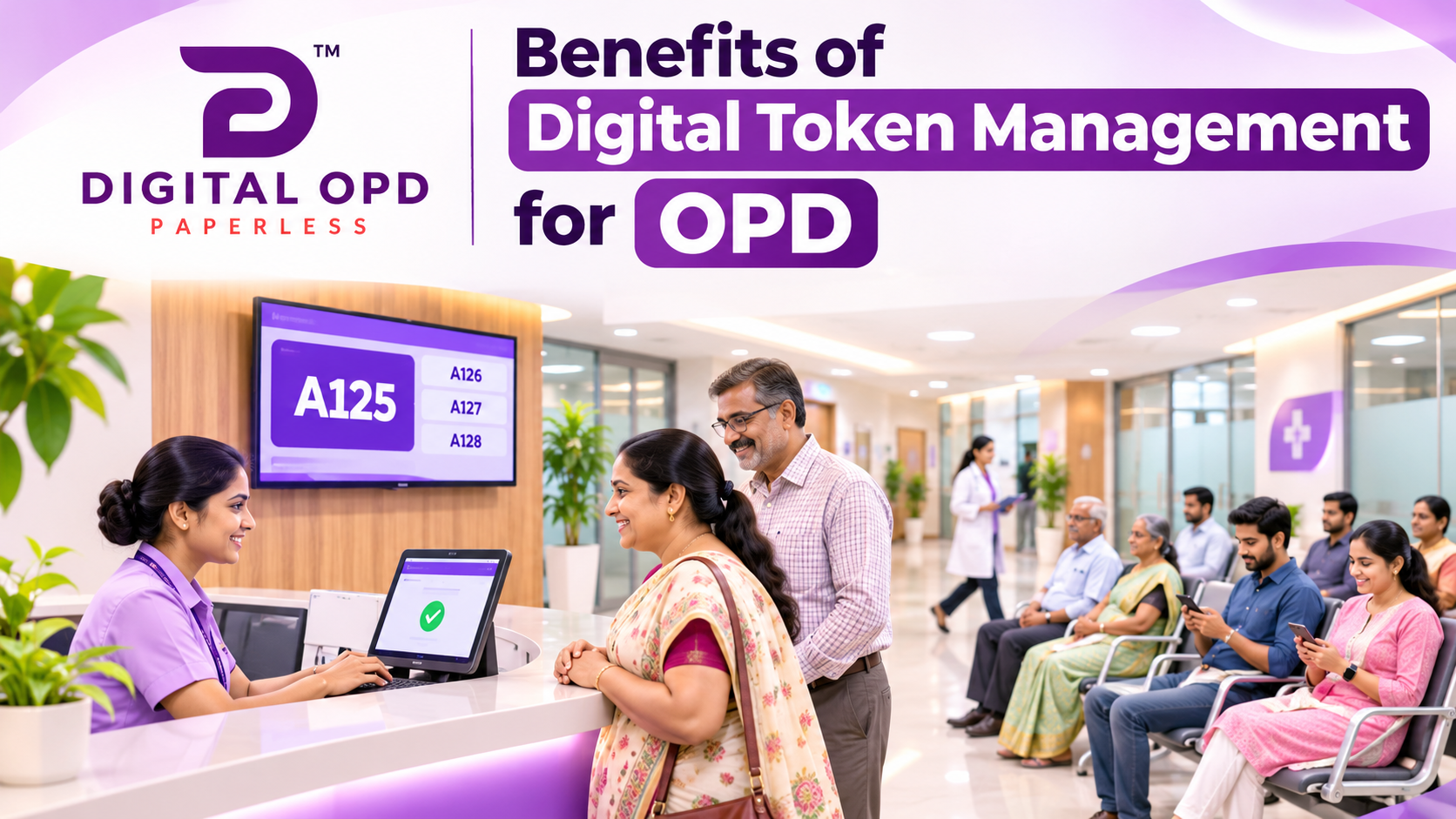
Digital token management replaces this fragmented process with a structured, technology-driven system. Upon arrival or even before reaching the hospital, a patient is assigned a unique digital token linked to their registration. This token is tracked through a centralized system that manages queue order, patient flow across different consultation rooms, and real-time status updates visible to both staff and patients.
The relevance of this in the Indian context is significant. India's public and private healthcare systems collectively handle hundreds of millions of OPD visits annually. The National Health Policy and initiatives like Ayushman Bharat have expanded healthcare access, which means patient footfall at registered hospitals and empanelled clinics has grown substantially. Without structured queue management, this increased volume creates chaos rather than better care.
Digital token management is not just a convenience feature. It is a foundational component of a modern, patient-centered OPD operation.
Key Operational Benefits for Hospitals and Clinics
Reduced Waiting Time and Better Patient Experience
One of the most direct and measurable benefits of digital token management is the reduction in actual and perceived waiting time. When patients know their token number and can see how many patients are ahead of them on a digital display screen or through an SMS update, the anxiety of uncertainty is significantly reduced.
Operational reports from healthcare institutions that have adopted digital queue systems consistently show reductions in patient waiting times by 30 to 50 percent. Even when the absolute wait remains the same, patients who receive real-time updates report higher satisfaction scores because they feel informed and in control.
For Indian hospitals, particularly those dealing with 200 to 500 OPD patients per day, this reduction in perceived waiting time directly translates into better patient feedback, fewer complaints at the front desk, and a more organized reception environment.
Improved Front-Desk Efficiency
The front-office team in any hospital or clinic carries a significant operational burden. They handle patient registration, query management, appointment scheduling, billing coordination, and general patient guidance all at once. When the token system is manual, a significant portion of their energy goes toward managing the physical queue, answering questions like "How many patients are ahead of me?" or managing disputes between patients about their position.
Digital token management automates queue assignment entirely. The system generates and assigns tokens without manual intervention, updates queue status in real time, and communicates directly with patients through SMS or display boards. This frees front-desk staff to focus on higher-value interactions such as registration accuracy, patient guidance, and billing support.
Doctor-Wise and Department-Wise Queue Control
A major advantage of modern digital token systems is the ability to manage queues not just at the reception level but at the individual doctor or department level. In a multi-specialty hospital, patients visiting the orthopedics department, the general physician, and the pediatrics unit all require separate queue management. A unified digital token system can handle all of these simultaneously, with each consultation room operating its own organized flow.
This granular queue control also allows hospitals to balance patient loads across doctors, send patients to less-occupied consultation rooms where appropriate, and give department heads clear visibility into daily OPD volumes. For clinic chains operating across multiple locations in cities like Bengaluru, Pune, Hyderabad, or Lucknow, this centralized visibility is especially valuable.
Reduction in OPD Crowding and Safety Compliance
Post-pandemic healthcare operations in India have placed renewed emphasis on infection control and crowd management within clinical spaces. Digital token systems contribute directly to this by reducing the number of patients physically present in the waiting area at any given time. When patients receive updates on their estimated wait time, they can remain outside, in their vehicles, or in designated open areas rather than crowding indoors.
This aligns with guidelines from the Ministry of Health and Family Welfare and infection control standards supported by bodies like NABH, which encourage healthcare facilities to minimize unnecessary patient congregation within clinical premises.
Impact on Patient Engagement and Communication
Real-Time Updates and SMS Notifications
Modern digital token management platforms send automated SMS notifications to patients at key stages of their OPD visit. A patient might receive a message when their token is generated, when they are five patients away from consultation, and when the doctor is ready to see them. This simple communication loop keeps patients informed without requiring them to approach the front desk repeatedly.
For hospitals serving patients from semi-urban or rural areas around Tier 2 cities, SMS-based notifications are particularly effective because they work without requiring a smartphone or internet connection. This makes the system inclusive rather than accessible only to digitally literate patients.
Alignment with ABDM and Digital Health Goals
India's Ayushman Bharat Digital Mission (ABDM) is building a connected healthcare ecosystem where patient data, appointments, prescriptions, and health records are linked through Ayushman Bharat Health Account (ABHA) IDs. Digital token management systems that integrate with ABDM-compliant platforms contribute to this broader national goal by creating a structured digital record of patient visits, appointment flow, and consultation timelines.
Hospitals and clinics that adopt digital OPD tools, including token management, are better positioned to meet regulatory expectations as Indian health digitization matures.
Analytical and Management Advantages
OPD Performance Data and Reporting
One of the less-discussed but highly valuable benefits of digital token management is the data it generates. Every token issued, every wait time recorded, and every consultation completed creates a data point that can be analyzed to understand OPD performance.
Hospital administrators and medical directors can use this data to answer important operational questions:
Which time slots see the highest patient volume?
Which doctors consistently run behind schedule, and why?
What is the average OPD wait time per day, per week, or per month?
How does patient footfall vary across weekdays?
These insights enable smarter scheduling, better resource allocation, and more strategic decisions about staffing and capacity. For hospital owners and clinic founders looking to grow their practice, this kind of data-driven visibility is invaluable.
Reduced Manual Errors and Paperwork
Manual token systems are prone to errors. Duplicate token numbers, lost slips, incorrect queue order, and miscommunication between front-desk staff and consultation rooms are common problems. Digital token management eliminates these issues by maintaining a single, centralized, and continuously updated source of truth for the entire OPD queue.
The reduction in paperwork also aligns with the broader push toward paperless hospital operations, which is a goal shared by NABH accreditation standards and modern hospital management principles.
Practical Considerations for Implementation in Indian Healthcare Settings
Scalability Across Hospital Sizes
One of the common misconceptions about digital token systems is that they are only suitable for large hospitals. In reality, scalable digital token management platforms can be configured for a single-doctor clinic in a Tier 2 town with 30 patients per day or a large multi-specialty hospital in a metro city handling 1,000 or more OPD visits daily.
The key is choosing a platform that offers flexible configuration, intuitive staff interfaces, and patient-facing tools that do not require complex setup. Platforms like Digital OPD are built with this scalability in mind, ensuring that even smaller practices can benefit from organized queue management without heavy investment in infrastructure.
Staff Training and Change Management
Transitioning from a manual system to a digital token management platform requires brief but focused staff training. Front-desk teams need to understand how to register patients, assign tokens, handle exceptions, and communicate with patients who may not be comfortable with digital processes.
Most modern platforms offer simple dashboards that require minimal technical expertise. The learning curve is short, and within a few days of implementation, staff typically find the digital system significantly easier to manage than manual alternatives.
Frequently Asked Questions
Q1: What is digital token management in OPD?
Digital token management in OPD is a system that assigns patients a unique digital token number upon registration, allowing them to track their position in the queue in real time without standing in physical lines. The system automates queue assignment, updates wait status continuously, and notifies patients through SMS or display screens.
Q2: How does digital token management reduce waiting time in hospitals?
By automating queue assignment and sending real-time updates to patients via SMS or display screens, digital token systems eliminate the need for crowded waiting areas and allow patients to arrive closer to their actual consultation time. When patients know how long they will wait, they can use that time more productively instead of sitting in a crowded reception.
Q3: Is digital token management suitable for small clinics in India?
Yes. Digital token management systems are scalable and can be implemented in small single-doctor clinics as well as large multi-specialty hospitals across Tier 1 and Tier 2 cities in India. The configuration and pricing models of most platforms are designed to accommodate practices of varying sizes.
Q4: Can digital token systems integrate with hospital management software?
Most modern digital token management platforms are designed to integrate with existing hospital management systems, appointment scheduling tools, and billing software to create a unified OPD workflow. This integration ensures that patient data entered at registration flows seamlessly across all departments without repeated manual entry.
Q5: What are the key features to look for in an OPD digital token system?
Key features include real-time queue tracking, SMS or app-based patient notifications, doctor-wise token management, analytics and reporting, self-registration support, and integration with billing and prescription systems. Platforms that also support ABDM compliance and multilingual interfaces are particularly suitable for the diverse Indian healthcare context.
Resources
Ayushman Bharat Digital Mission (ABDM): Official government initiative for building a connected digital health ecosystem in India, including ABHA ID and health record integration.
National Health Authority (NHA), Government of India: Policy and implementation body overseeing Ayushman Bharat and digital health programs relevant to OPD management.
National Accreditation Board for Hospitals and Healthcare Providers (NABH): Standards and guidelines for hospital operations, patient safety, and OPD management practices.
Ministry of Health and Family Welfare (MoHFW): Central government body setting healthcare policy, infection control guidelines, and hospital operational standards applicable to outpatient departments.
World Health Organization (WHO) India: Global and regional guidance on patient safety, healthcare quality, and outpatient care improvement strategies relevant to Indian healthcare providers.
Interlinking Keywords
OPD queue management, digital token system for hospitals, patient flow management, outpatient department efficiency, hospital front desk operations, appointment scheduling software, digital OPD platform, NABH compliance for OPD, ABDM digital health integration, OPD wait time reduction, patient engagement in OPD, paperless hospital operations
Last reviewed by:
Dr. Manthan Tripathi and Editorial Advisory Team, Digital OPD on 3, November 2026.
Disclaimer
The information presented in this article is intended for general informational and educational purposes only. It is directed toward healthcare providers, hospital administrators, clinic owners, and healthcare decision-makers seeking to understand digital token management and its operational benefits in outpatient departments. This content does not constitute medical advice, clinical guidance, or a recommendation to adopt any specific technology platform or vendor. Healthcare providers should conduct their own evaluation of digital solutions based on their specific operational needs, patient demographics, regulatory environment, and institutional goals. References to government bodies, accreditation standards, and digital health initiatives are provided for contextual accuracy and do not imply endorsement of any specific product or service by those bodies.