Introduction
Running a small clinic in India has never been a simple task. Every single day, clinic owners and doctors manage a constant flow of patients, handle stacks of paper records, coordinate appointment scheduling manually, and try to keep billing accurate without any systemic support. For many small clinics across Tier 1 and Tier 2 cities, this daily grind has remained unchanged for decades.
But the healthcare landscape in India is shifting rapidly. Patients today expect faster registration, digital receipts, online appointment options, and smoother waiting room experiences. Government initiatives such as the Ayushman Bharat Digital Mission (ABDM) are actively pushing healthcare providers toward digital health records and interoperable patient data systems. In this environment, small clinics that continue to rely entirely on manual processes risk falling behind, both in operational efficiency and in patient satisfaction.
The good news is that digitizing a small clinic does not require a massive budget or a dedicated IT team. It requires the right digital tools, a clear plan, and a willingness to rethink how daily operations are managed. This article provides a step-by-step practical guide for small clinic owners and doctors in India who want to modernize their clinic without complicating things for their staff or their patients.
Understanding What Clinic Digitization Actually Means
Before exploring the how, it is important to understand what digitization actually means for a small clinic. Clinic digitization is not about replacing doctors with technology or spending heavily on complex software systems. It is about replacing slow, error-prone, paper-based workflows with faster, more reliable digital alternatives.
A digitized clinic typically handles the following through software or digital platforms rather than paper or manual effort:
Patient registration and data capture
Appointment booking and scheduling
Queue and token management
Doctor consultation notes and prescriptions
Billing and payment processing
Follow-up reminders and patient communication
OPD performance tracking and reports
When these processes move to a digital system, clinics immediately gain better speed, fewer errors, improved visibility into daily operations, and a significantly better experience for patients.
India's National Health Policy and ABDM framework both envision a future where every patient has a digital health ID and every provider contributes to a connected health ecosystem. Small clinics that begin digitizing now are not just improving their own operations. They are also positioning themselves to align with national health infrastructure as it evolves.
The Biggest Operational Challenges Small Clinics Face
To understand why digitization matters, it helps to first look at the problems that most small clinics deal with on a daily basis. These are not unique situations. They are shared experiences across thousands of clinics in cities and towns across India.
One of the most common challenges is long waiting times. When registration happens on paper, tokens are handed out manually, and doctors have no visibility into the queue, waiting times stretch unnecessarily. Patients become frustrated, and front-desk staff feel overwhelmed during peak hours.
Repeated data entry is another significant problem. Every time a returning patient visits, their information is filled out again from scratch. There is no central record. Prescriptions are handwritten, often illegible, and easily lost. Billing involves manual calculations that are prone to mistakes.
Missed follow-ups are also a common pain point. Without a system to track which patients need to return for a review or for a test result, many follow-ups simply do not happen. This affects patient health outcomes and reduces the long-term patient retention that small clinics depend on.
Finally, there is the problem of management visibility. Clinic owners often have no easy way to understand how many patients were seen in a day, which doctors were busiest, what revenue was generated, or where operational bottlenecks occurred. Without data, it is very difficult to make informed decisions about staffing, scheduling, or service improvements.
Key Steps to Digitize a Small Clinic
Digitizing a small clinic is a step-by-step process. Doing everything at once is neither practical nor advisable. The most successful transitions happen when clinics take a phased approach, starting with the highest-impact areas and gradually expanding from there.
Start With Patient Registration and Appointment Booking
The first and most impactful area to digitize is patient registration and appointment management. A digital registration system allows patients to fill in their basic details before arriving at the clinic, either through a kiosk at the front desk or through an online form. This eliminates the repetitive process of manually writing down names, phone numbers, ages, and medical history every visit.
Online appointment booking is equally important. When patients can book their slot in advance through a website, an app, or even a WhatsApp-based system, it reduces walk-in crowding and allows the clinic to plan the day better. Doctors can see their scheduled appointments in advance, which makes consultations more organized and reduces idle waiting time for everyone.
Implement Digital Queue and Token Management
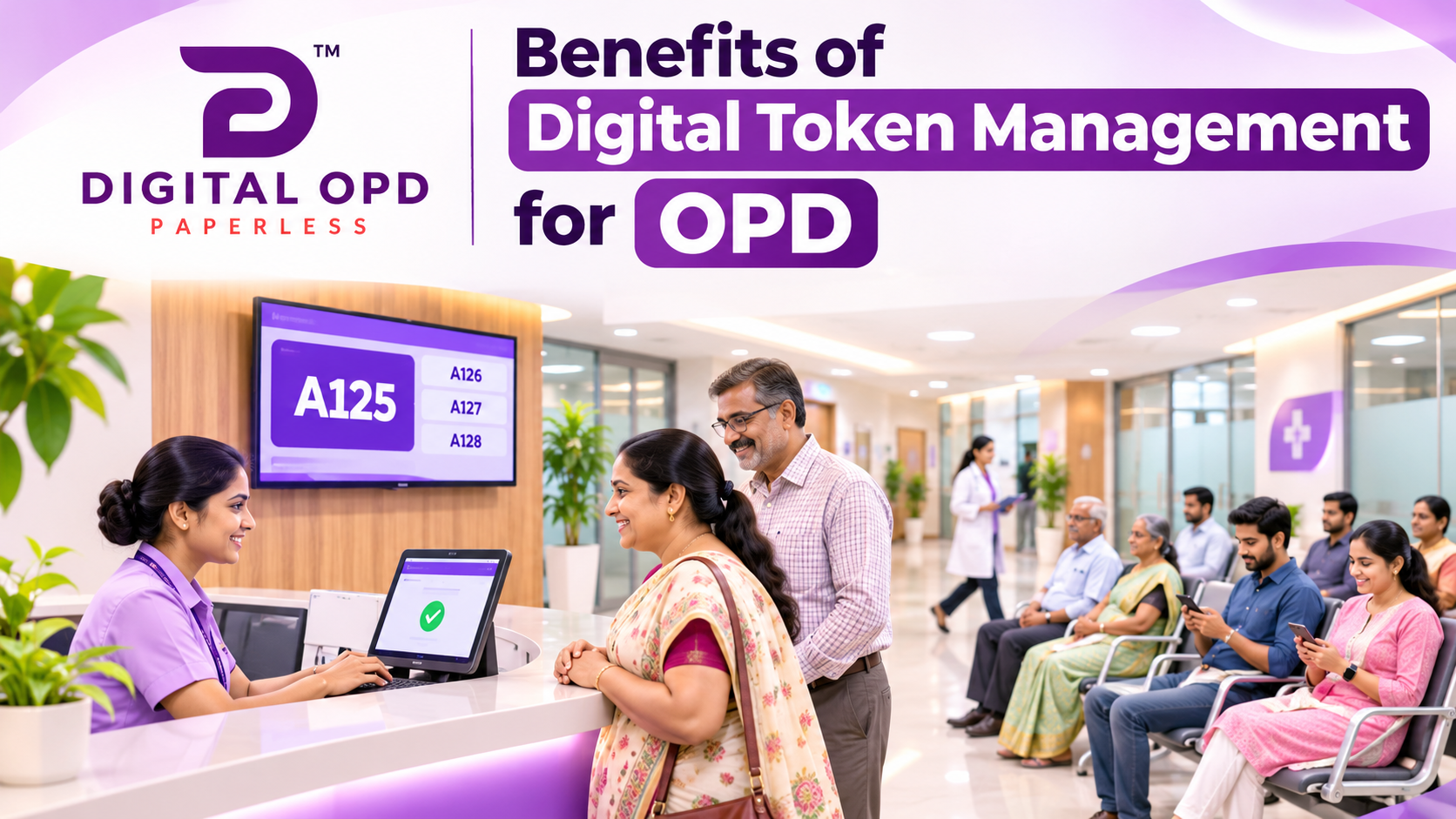
For clinics that see a high volume of daily patients, queue management is often the most visible pain point. A digital token system removes the chaos from the waiting area. Patients receive a token number at registration and can track their position in the queue on a display screen or through an SMS or app notification. This reduces crowding at the front desk and allows patients to wait more comfortably.
Queue management also gives the doctor and front-office team real-time visibility into patient flow throughout the day. This makes it easier to handle unexpected surges and to plan breaks without disrupting the overall schedule.
Move to Digital Prescriptions and Consultation Notes
Handwritten prescriptions are one of the most persistent sources of errors in outpatient care. Illegible handwriting, incomplete dosage instructions, and missing medication information can all lead to problems for patients at the pharmacy or during follow-up consultations.
Digital prescription tools allow doctors to generate typed, clear, and complete prescriptions directly during the consultation. These can be printed or shared digitally with the patient via SMS or email. Over time, digital consultation notes also build a rich medical history for each patient, making future consultations faster and better informed.
For clinics registered under ABDM, digital prescriptions linked to a patient's ABHA (Ayushman Bharat Health Account) ID contribute directly to that patient's longitudinal health record. This is not just good practice. It is increasingly becoming an expected standard across the Indian healthcare system.
Digitize Billing and Payment Processes
Manual billing is slow, error-prone, and creates reconciliation headaches at the end of every day. A digital billing system can automatically generate invoices based on consultation fees, procedure charges, and any items dispensed at the clinic. Payments can be accepted via UPI, card, or cash, with digital receipts issued instantly.
Beyond speed and accuracy, digital billing also provides the clinic with accurate daily, weekly, and monthly revenue records. This eliminates the guesswork from financial management and makes accounting significantly simpler.
Set Up Automated Follow-Up and Patient Communication
A patient who misses a follow-up visit is a gap in care that can be easily prevented with the right tools. Automated follow-up reminders, sent via SMS or WhatsApp, can prompt patients to return for their next visit, collect pending reports, or schedule the next consultation. This kind of proactive communication is a simple but powerful way to improve patient outcomes and build long-term loyalty.
Automated messages can also be used to share post-visit instructions, medication reminders, and general health tips. These small touchpoints make patients feel cared for even outside the clinic, which significantly strengthens the doctor-patient relationship.
ABDM Alignment and Why It Matters for Small Clinics
The Ayushman Bharat Digital Mission is India's national digital health infrastructure initiative. It connects patients, providers, pharmacies, labs, and insurers through a common digital framework built around the ABHA ID, the Health Facility Registry (HFR), and the Healthcare Professionals Registry (HPR).
For small clinics, ABDM alignment means registering the clinic in the Health Facility Registry and enabling the ability to link patient records to ABHA IDs. This is not mandatory at this stage for all providers, but the direction of Indian healthcare policy is clearly moving toward universal digital health record linkage.
Clinics that begin aligning with ABDM now will find it easier to participate in government insurance schemes, accept Ayushman Bharat PM-JAY claims, and meet future regulatory expectations. More practically, ABDM-compliant systems give patients and their families a connected view of their health history across different providers, which improves the overall quality of care.
Choosing the Right Digital OPD Platform for Your Clinic
Not all clinic management software is built the same way, and small clinics have specific needs that differ from large hospitals. The right platform should be easy to set up and use, require minimal training for staff, be affordable on a small-clinic budget, and be capable of growing with the practice over time.
A good digital OPD platform for a small clinic should offer:
Simple patient registration and profile management
Appointment scheduling with doctor-wise slots
Digital queue or token management
Easy prescription generation and sharing
Integrated billing and payment support
Automated reminders and follow-up communication
Basic reporting and daily OPD analytics
Platforms like Digital OPD are designed with exactly these requirements in mind. They focus on making the entire outpatient journey faster and more organized for both the clinic team and the patient, without overwhelming staff with complicated features or requiring expensive hardware investments.
Common Concerns About Clinic Digitization
Many small clinic owners hesitate to digitize because of common concerns that are worth addressing directly.
The first concern is cost. Digital OPD platforms today are far more affordable than they were five or ten years ago. Many platforms offer subscription-based pricing that is accessible even for single-doctor clinics. The return on investment, in terms of time saved, errors reduced, and patient retention improved, typically outweighs the cost within a few months.
The second concern is staff training. Most modern clinic management platforms are designed to be intuitive. Front-desk staff can typically learn the basics within a day or two, and most vendors provide onboarding support and training materials.
The third concern is patient adoption. Not all patients are comfortable with digital interfaces, and this is a genuine consideration, especially in smaller towns. However, most digital OPD platforms are designed to work with minimal patient interaction. The digital work happens on the clinic side. Patients simply register, receive a token, and are called in when it is their turn.
Conclusion
The shift toward digitized clinic operations is no longer a distant aspiration for Indian healthcare. It is a practical and increasingly necessary step for small clinics that want to deliver better care, reduce operational inefficiencies, and stay relevant in a healthcare environment that is changing rapidly.
Digitization does not have to happen all at once. Starting with patient registration, appointment booking, and queue management creates an immediate and visible improvement in the daily clinic experience. Adding digital prescriptions, billing, and follow-up communication builds on that foundation over time.
For clinic owners and doctors who have been running their practices manually for years, the transition to a digital OPD model may feel like a significant change. But with the right platform and a phased approach, it is entirely achievable and genuinely transformative. The clinics that begin this journey today are the ones that will be best positioned to serve their patients and grow their practice in the years ahead.
Frequently Asked Questions
Q1: What is the first step a small clinic should take to start digitizing its operations?
The most practical first step is to implement a digital patient registration and appointment booking system. This single change reduces front-desk workload, eliminates repetitive data entry, and immediately improves the patient experience at the point of entry. From there, clinics can gradually add queue management, digital prescriptions, billing, and follow-up tools.
Q2: How much does clinic management software typically cost for a small clinic in India?
The cost varies depending on the platform and features chosen. Many modern clinic management and digital OPD platforms offer affordable monthly or annual subscription plans designed for small clinics. Entry-level plans can start from a few hundred to a few thousand rupees per month, depending on the scope of features. Costs have come down significantly in recent years, making digitization accessible even for single-doctor practices.
Q3: Is it necessary for small clinics to align with the Ayushman Bharat Digital Mission (ABDM)?
ABDM alignment is not currently mandatory for all small clinics, but it is strongly encouraged by the government as part of India's national digital health strategy. Clinics that register in the Health Facility Registry and enable ABHA ID linking are better positioned to participate in government health schemes, accept digital health records, and meet future regulatory standards. Starting early makes the transition smoother.
Q4: Can a small clinic digitize without hiring an IT professional?
Yes. Most modern digital OPD platforms are designed to be deployed and managed without any technical expertise. Vendors typically provide setup support, onboarding assistance, and ongoing customer service. Staff training is usually straightforward, and the platforms are built to be usable by front-desk teams without any background in IT or software.
Q5: How does digitization improve patient experience at a small clinic?
Digitization improves the patient experience in several meaningful ways. Online appointment booking reduces unnecessary waiting. Digital token systems allow patients to wait comfortably without crowding the reception area. Digital prescriptions are clearer and easier to follow than handwritten ones. Automated follow-up reminders keep patients engaged with their care. Together, these improvements make a visit to a digitized clinic noticeably faster, smoother, and more professional.
Resources
Ayushman Bharat Digital Mission (ABDM): Official platform for India's national digital health infrastructure, including ABHA ID registration and Health Facility Registry guidelines.
Ministry of Health and Family Welfare, Government of India: Policy documents, national health programs, and regulatory guidance relevant to clinic operations and digital health adoption.
National Health Authority (NHA): The implementing agency for PM-JAY and ABDM, with resources for healthcare providers looking to integrate with government health schemes.
NABH (National Accreditation Board for Hospitals and Healthcare Providers): Quality standards and accreditation guidelines for clinics and hospitals in India, including digital documentation requirements.
National Health Policy 2017, Ministry of Health and Family Welfare: Framework document outlining India's vision for universal health coverage and the role of digital health in achieving it.
Interlinking Keywords
digital OPD management, clinic management software India, paperless clinic India, online appointment booking clinic, digital prescription software, patient registration system, ABDM clinic registration, outpatient queue management, clinic billing software, small clinic digital tools
Last reviewed by:
Dr. Manthan Tripathi and Editorial Advisory Team, Digital OPD on 13, October 2026.
Disclaimer
The information provided in this article is intended for general informational and educational purposes only. It is directed at healthcare providers, clinic owners, and healthcare administrators. This article does not constitute medical advice, clinical guidance, or legal counsel. Readers are advised to consult qualified professionals before making decisions related to technology adoption, regulatory compliance, or operational changes in their healthcare practice. Digital OPD and its associated content do not guarantee specific outcomes from the adoption of digital tools described in this article.